
One of the unexpected benefits of building The Frictionless Man has been discovering how differently marketing feels when you stop studying theory and start observing behaviour directly.
Before launching the website, I spent a lot of time reading about SEO, conversion rate optimisation, messaging psychology, behavioural economics, and content strategy. Like most marketers, I understood the concepts intellectually.
But understanding an idea and watching it play out in real-world conditions are very different experiences.
That difference became particularly clear when I started running behavioural experiments using Facebook traffic and Google Analytics 4.
Initially, the goal seemed straightforward. I wanted to understand whether different messaging styles influenced user behaviour. But very quickly another question emerged:
How do you design a marketing experiment that actually teaches you something?
Because changing things randomly isn’t experimentation.
It’s just activity.
And I think that’s where a lot of marketing “testing” quietly falls apart.
The Problem With Most Marketing Testing
One thing I’ve noticed while learning digital marketing is that many experiments aren’t really experiments at all.
A headline changes.
The image changes.
The audience changes.
The posting time changes.
Sometimes even the landing page changes.
If performance improves, it’s tempting to call that a successful test. The problem is that it’s often impossible to know what actually caused the improvement.
Was it the headline?
The image?
The audience?
The platform?
Or simple timing?
Without understanding the cause, repeating the result becomes difficult.
This is something I started noticing during the early phases of my behavioural testing on The Frictionless Man. As I explored different Facebook hook styles, traffic patterns changed noticeably. Some posts generated stronger responses than others, particularly those using sharper emotional framing.
Initially, I viewed that as a straightforward win.
More clicks felt like progress.
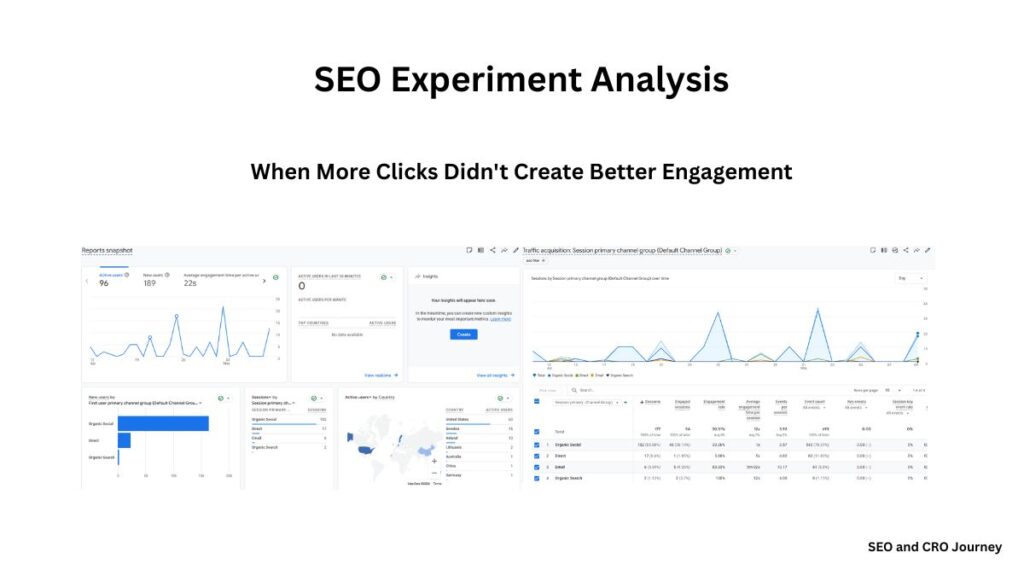
But after analysing the results more carefully, I realised something more important was happening. The increase in clicks wasn’t always producing stronger engagement once visitors arrived on the website.
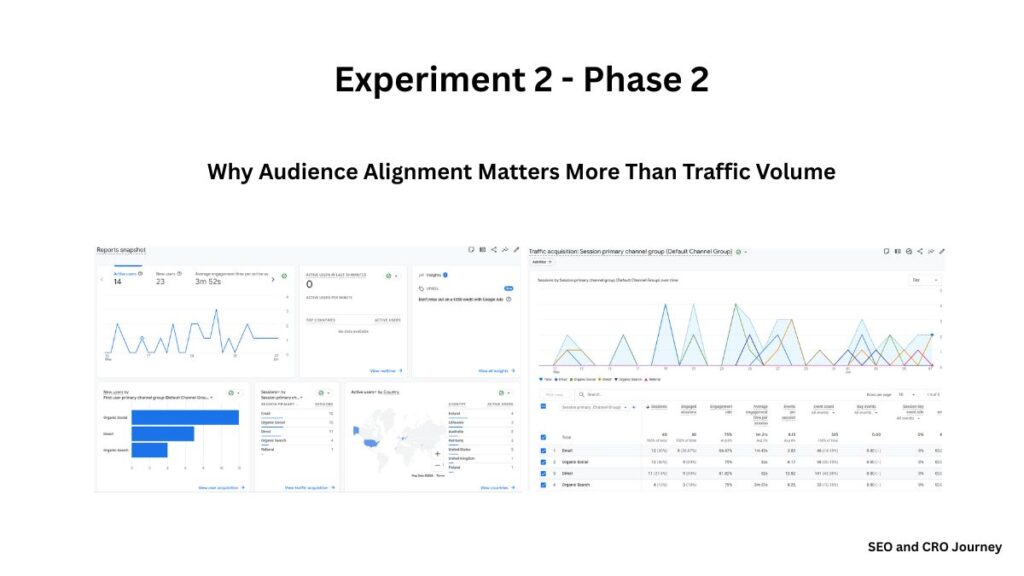
That insight eventually became the foundation for More Clicks Didn’t Create Better Engagement, where the focus shifted from traffic generation towards audience alignment.
The experience taught me that behavioural changes are only useful if you can confidently identify what caused them.
Why Simplicity Creates Better Experiments
Once I recognised this, my approach became much more constrained.
Instead of testing multiple variables simultaneously, I tried to change as little as possible.
The website remained the same.
The audience remained the same.
The articles remained the same.
The publishing schedule remained broadly consistent.
The only meaningful variable I intentionally changed was the messaging used to introduce the content.
At first, this felt overly restrictive.
Part of me wanted to test everything.
Different headlines.
Different article structures.
Different images.
Different platforms.
But the more I thought about it, the more I realised that every additional variable reduced the clarity of the outcome.
If behaviour changed significantly, I wanted a reasonable degree of confidence about why.
That confidence only comes from simplicity.
Ironically, limiting what you test often increases how much you learn.
The Marketing Experiment Framework I Now Use
As the experiments evolved, I found myself following a fairly consistent structure.
I wouldn’t describe it as a formal methodology, but it has become the framework I use whenever I want to test something intentionally.
1. One Primary Variable
The most important principle is keeping the experiment focused on a single meaningful change.
For my messaging experiment, that variable was psychological framing.
The content destination stayed consistent.
Only the presentation changed.
This allowed me to observe whether messaging alone influenced behaviour.
Whenever multiple variables change simultaneously, interpretation becomes far more difficult.
2. One Audience
Audience consistency matters more than I initially realised.
Different audiences arrive with different expectations.
They respond to different emotional triggers.
They consume content differently.
Throughout these experiments, I focused specifically on the audience The Frictionless Man was created for: midlife professional men navigating mental load, responsibility, identity, and cognitive fatigue.
Keeping that audience relatively stable made behavioural differences easier to interpret.
Otherwise, you’re often comparing different people rather than different marketing approaches.
3. One Behavioural Outcome
Another mistake I see frequently is trying to measure everything.
Marketing platforms provide endless metrics.
Clicks.
Impressions.
Engagement rates.
Session duration.
Bounce rates.
Events.
Conversions.
The temptation is to monitor all of them equally.
But experiments become clearer when you decide what behaviour matters most before you begin.
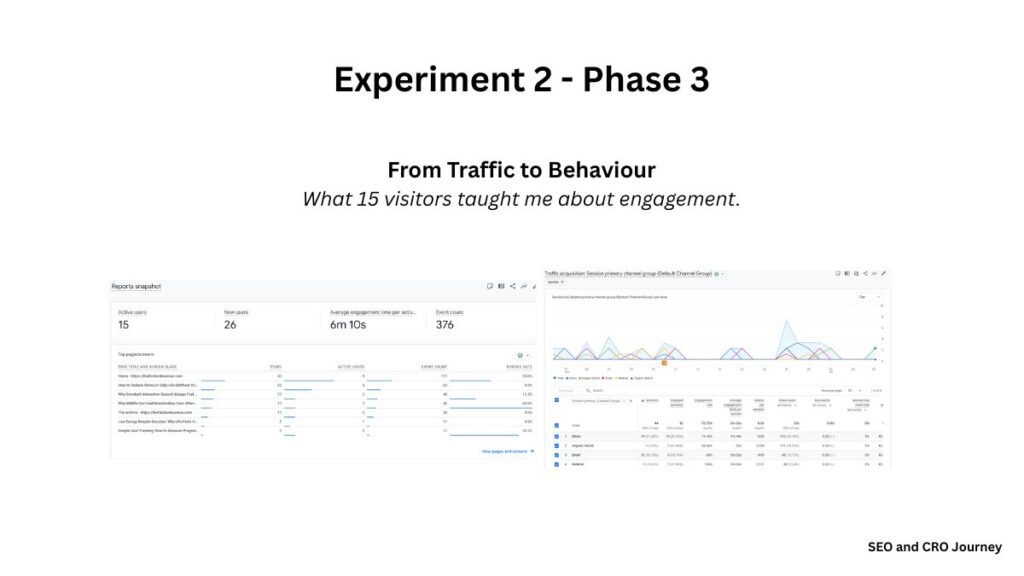
During different phases of my testing, the primary focus shifted between click behaviour and engagement behaviour.
Having a clear priority prevented me from becoming distracted by every movement inside the analytics dashboard.
This mindset was heavily influenced by what I learned while working with Google Analytics 4. As I discussed in What Google Analytics 4 Changed About How I Think About Behaviour, metrics only become useful when connected to actual human behaviour.
Otherwise, dashboards quickly become collections of numbers rather than meaningful observations.
4. One Clear Hypothesis
The final piece is having a prediction before starting.
Not because predictions are always correct.
Usually they aren’t.
But because hypotheses force clarity.
Instead of posting content and hoping something interesting happens, you begin with a specific assumption.
For example:
“I believe stronger emotional framing will generate more clicks.”
Or:
“I believe more personal storytelling will increase engagement duration.”
The result matters.
But the comparison between expectation and reality often matters even more.
Unexpected outcomes usually contain the most useful lessons.
Why Constraints Improve Learning
One of the biggest surprises for me has been how valuable constraints actually are.
Modern marketing encourages constant optimisation.
More channels.
More content.
More testing.
More activity.
Yet I’ve often found the opposite to be true.
The narrower the experiment becomes, the easier it is to understand.
Running a small behavioural experiment on a website with modest traffic probably sounds insignificant compared to large-scale marketing campaigns.
But small environments have advantages.
Patterns become easier to spot.
Behaviour becomes easier to observe.
And because there is less noise, individual variables often become more visible.
This is one reason I built The Frictionless Man in the first place.
As I explained in Why I Built a Second Website: A Marketing Experiment Platform, the website was never just a content project. It was designed as a practical environment where ideas about SEO, CRO, messaging, and behavioural psychology could be tested in real conditions.
The goal wasn’t scale.
The goal was learning.
Defining Success Before You Begin
Another lesson I’ve learned is that success should be defined before the experiment starts.
Otherwise, it’s very easy to move the goalposts afterwards.
If clicks increase, success becomes traffic.
If engagement improves, success becomes retention.
If neither improves, success suddenly becomes “learning.”
That flexibility feels comforting, but it often weakens the experiment itself.
Before starting a test, I now try to decide what success would realistically look like.
Importantly, success doesn’t always mean improvement.
Sometimes success simply means discovering something unexpected.
The audience behaved differently than anticipated.
A messaging style underperformed.
A popular assumption turned out to be wrong.
Those outcomes are often more valuable than confirming what you already believed.
What This Framework Has Changed For Me
Perhaps the biggest shift has been moving away from viewing marketing as a collection of tactics.
The more experiments I run, the more marketing starts to look like behavioural observation.
People aren’t responding to headlines.
They’re responding to expectations.
They’re responding to relevance.
They’re responding to how closely an experience aligns with what they hoped would happen after clicking.
That distinction feels subtle, but it’s changed how I think about content entirely.
Instead of asking:
“How do I get more clicks?”
I increasingly find myself asking:
“What expectation am I creating?”
And:
“Will the experience satisfy that expectation?”
Those questions sit at the intersection of SEO, CRO, psychology, and content strategy.
And they’re far more interesting than traffic alone.
Final Thought
The biggest lesson I’ve taken from building these experiments is surprisingly simple:
If everything changes, nothing is learned.
Good experimentation isn’t about sophisticated tools, large budgets, or complex dashboards.
It’s about creating enough structure that behaviour becomes interpretable.
Choose one variable.
Define one audience.
Measure one meaningful outcome.
Start with one clear hypothesis.
Then pay attention.
Because the most valuable outcome of a marketing experiment isn’t usually the result itself.
It’s understanding why the result happened.
And once you understand that, you’re no longer guessing.
You’re learning.
Here’s to progress (and fewer 404s)
Chris