

When I first started learning digital marketing, I assumed analytics was mostly about traffic. The logic seemed fairly straightforward: more visitors meant growth, fewer visitors meant something needed improving. Like many people learning SEO for the first time, I viewed analytics as a kind of performance scoreboard — a way to confirm whether the work being done was increasing visibility over time.
Then I started spending more time inside Google Analytics 4, and fairly quickly I realised traffic alone explains very little about what people are actually experiencing once they arrive on a website.
A visit tells you someone clicked. It does not tell you whether the page made sense to them, whether they found what they expected, or whether something quietly caused them to lose interest after a few seconds. That distinction changed how I think about websites entirely.
Before using GA4 regularly, I assumed most website problems were probably visibility problems. If traffic increased, surely performance would improve alongside it. But the more I looked at user behaviour, the harder that assumption became to hold onto. People can arrive on a website and still feel uncertain. They can click a page and leave almost immediately. They can spend time reading one article while ignoring another that appears structurally similar.
What surprised me most was that some of the numbers initially seemed contradictory. During a recent experiment on The Frictionless Man, organic social traffic was generating relatively strong event activity per session, yet average engagement time looked extremely low. At first I assumed the tracking must be wrong because the metrics did not seem to align logically.
But the longer I sat with the data, the more I realised something important: metrics rarely explain behaviour properly in isolation.
A short session duration does not always mean failure. High pageviews do not automatically indicate value. Even engagement metrics require interpretation rather than assumption. GA4 forced me to stop looking for simple “good” or “bad” numbers and start paying more attention to behavioural patterns instead.
That shift changed analytics from something technical into something observational.
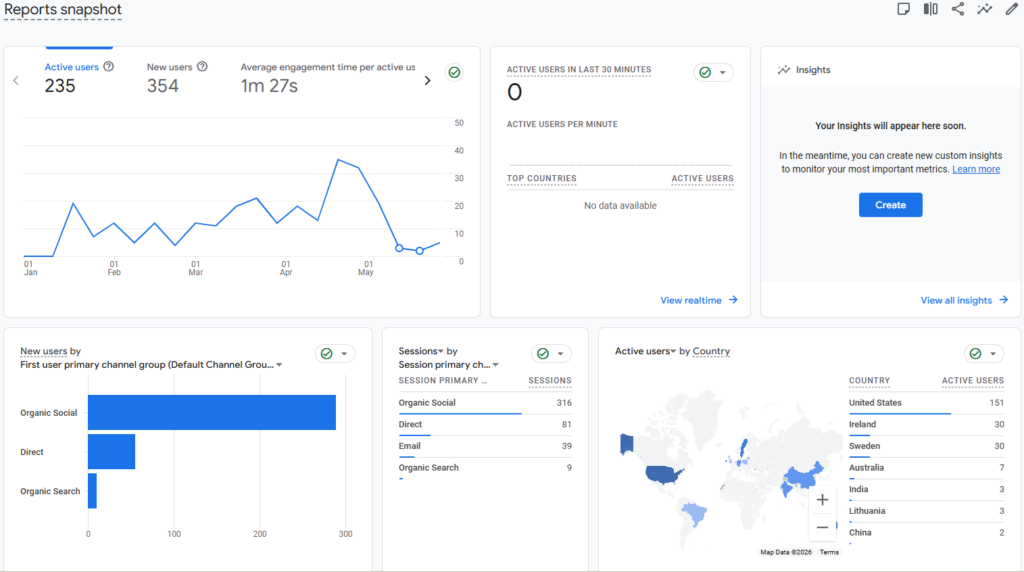
I started asking different questions. Instead of focusing purely on “How much traffic did this page get?”, I found myself thinking more about what the visitor was likely experiencing once they arrived.
Did the headline create curiosity?
Did the structure feel clear?
Did people hesitate?
Did the messaging align with expectation?
Was the page easier to leave than continue reading?
Those questions pushed me closer to CRO thinking without fully realising it at first.
SEO brings people to a page, but behaviour determines whether they stay. That distinction now feels incredibly important.
A large part of this shift came from running a four-week messaging experiment using The Frictionless Man. The structure itself was intentionally simple. I kept the destination page consistent while changing the psychological framing of the Facebook posts linking to it. Each week used a different hook style:
- calm framing
- sharper problem framing
- personal story
- stronger conviction
What surprised me was not simply that the results varied. It was how sensitive user behaviour appeared to be. Small wording changes influenced click behaviour, engagement patterns, and perceived relevance far more than I expected.
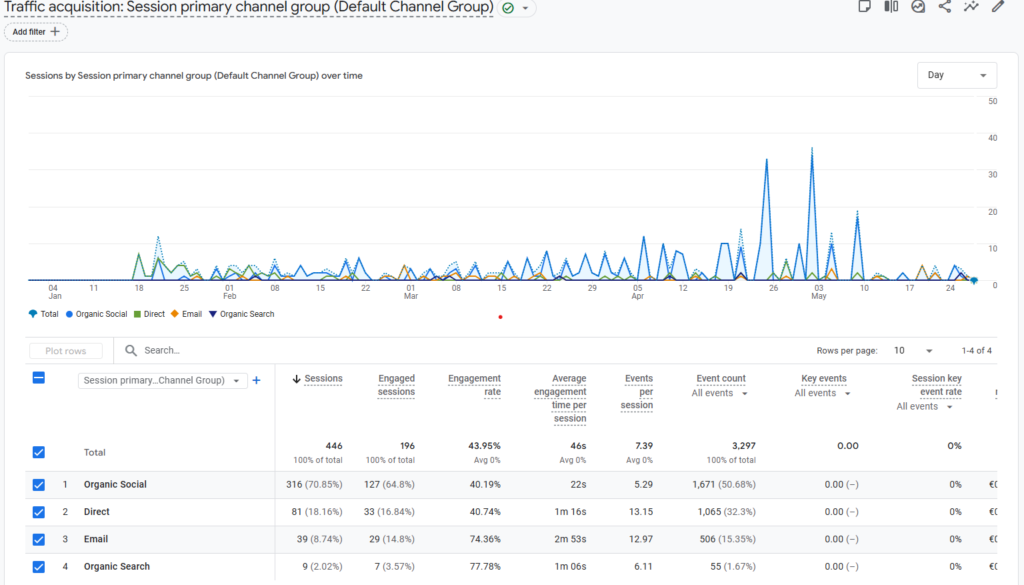
That experiment made analytics feel practical rather than abstract. Instead of dashboards existing separately from content, I began seeing a direct relationship between messaging, expectation, and behaviour. Every metric suddenly represented a real person making a decision. Someone clicked, someone stayed longer than expected, someone hesitated and someone left almost immediately.
The data stopped feeling technical and started feeling psychological.
One of the easiest traps when learning analytics is assuming higher traffic automatically means success. I understand why people think this because traffic is visible and easy to compare week to week. But traffic without behavioural understanding becomes misleading very quickly. A page can attract visitors while still creating confusion and a headline can generate clicks while failing to hold attention. Social posts can perform well algorithmically while attracting an audience that was never genuinely aligned with the content in the first place.
What I started noticing instead was that some of the most useful insights appeared in smaller behavioural shifts rather than dramatic traffic spikes. Slightly longer engagement times, more intentional interactions, or clearer visitor pathways often felt more meaningful than raw visitor volume because they suggested alignment rather than exposure alone.
The longer I work with analytics, the more I realise interpretation matters just as much as measurement itself. Two people can look at the same dashboard and draw completely different conclusions depending on what they focus on. That is partly why I have become increasingly interested in behavioural psychology alongside analytics. Numbers only become useful when connected to human motivation, attention, and decision-making.
Without that layer, dashboards risk becoming collections of disconnected metrics rather than meaningful observations.
Interestingly, GA4 also changed how I think about website structure itself. I started paying more attention to clarity, pacing, cognitive load, and friction — not because someone told me to optimise those things, but because user behaviour kept pointing toward them repeatedly.
Small moments of hesitation matter online, confusion matters, unclear pathways matter. A visitor rarely announces they feel uncertain; they simply leave.
That realisation pushed me toward viewing optimisation less as persuasion and more as simplification. Good websites reduce mental effort. They make the next step feel obvious and remove unnecessary decisions wherever possible.
One thing that became increasingly clear while using GA4 was that behaviour only tells part of the story. Understanding what visitors do after arriving matters enormously, but it also raised another question for me: what caused them to arrive in the first place? That’s where Google Search Console started changing how I think about visibility, impressions, and search intent itself. I explored that shift further in What Google Search Console Taught Me About SEO Expectations, where the focus moves from on-site behaviour toward how people discover content before they ever click.
When I first opened Google Analytics 4, I thought I was learning reporting software, what I was actually learning was how behaviour leaves patterns behind.
That distinction feels important because analytics is often presented as technical knowledge when in reality it sits much closer to psychology than many people realise. People do not behave rationally online, they behave emotionally, habitually, and often subconsciously. GA4 does not explain those motivations directly, but it reveals traces of them if you pay attention carefully enough.
The biggest shift analytics created for me was moving my attention away from performance alone and toward experience. Traffic matters, visibility matters, and growth matters — but behaviour explains whether any of those things are actually meaningful.
I still consider myself early in this learning process, but one thing already feels clear: analytics is far less about counting visitors than understanding what visitors are responding to once they arrive.
And increasingly, marketing itself feels less like broadcasting information and more like observing human behaviour carefully enough to reduce unnecessary friction.
Here’s to success (and fewer 404’s)
Chris