
One of the easiest traps to fall into when learning digital marketing is to start with the data.
How many visitors did the website receive?
How many clicks did the campaign generate?
How many people engaged with the post?
What was the conversion rate?
The numbers are there, the dashboards are full of them and, if you spend enough time looking at analytics platforms, it is remarkably easy to feel as though you are doing marketing simply because you are measuring something.
I have been guilty of this myself.
When I first started learning SEO and CRO, I was naturally drawn towards the numbers. Traffic, clicks, impressions, engagement and conversions all appeared to offer some kind of answer. The more I learned, the more data I could find.
But over time, I started to realise that the more important question was not necessarily, “What data do we have?”
It was:
What are we actually trying to achieve, what behaviour would indicate progress and which metrics would help us make a better decision?
That is a very different way of thinking about measurement.
It also became particularly relevant while developing The Frictionless Man as a marketing experiment platform. The website did not have thousands of visitors. There was no enormous dataset from which I could confidently declare that one strategy had definitively outperformed another.
Instead, I was often working with small amounts of information.
That created an important lesson.
Limited data does not mean there is nothing to learn, it simply means you need to be much more careful about what you believe the data is actually telling you.
Start With The Business Objective
The first question in a marketing strategy should not be: How much traffic do we need?
It should be: What is the organisation actually trying to achieve?
The answer might be to increase revenue, enter a new market, launch a product, improve customer retention, generate more qualified leads or reduce customer acquisition costs.
These are business objectives.
Marketing may contribute to achieving them, but marketing activity is not the same thing as the business outcome.
This distinction sounds obvious, but it is easy to lose sight of when working with digital channels.
A marketing team can increase website traffic, generate social media engagement and produce a growing number of impressions while the business itself is no closer to achieving its objective.
That does not necessarily mean the marketing activity was worthless.
It may simply mean that the wrong question was being asked of the data.
I have started to think about this in relation to my previous career in the pharmaceutical industry. A sales representative could have an extremely busy day, visiting multiple healthcare professionals and having a large number of conversations, but activity alone did not define success.
The activity only mattered in relation to the broader commercial objective.
Digital marketing is not fundamentally different.
A large amount of activity can still be disconnected from the outcome the organisation actually needs.
Before choosing metrics, it is therefore worth asking: What does the business need to achieve?
Only after answering that question should we start thinking about how marketing can contribute.
Translate The Business Objective Into A Marketing Objective
The business objective and the marketing objective are related, but they are not necessarily the same thing.
Imagine that a business wants to increase revenue from a new customer segment.
The marketing objective might be to increase qualified demand from that audience.
That could involve helping the right people discover the brand, engage with relevant content, return to the website, explore a product or service and eventually become a customer.
Notice that the marketing objective is not simply: Increase website traffic.
Traffic may be part of the journey.
But traffic by itself does not tell us whether marketing is contributing to the business objective.
This is one of the reasons I have become more interested in the relationship between SEO, CRO and broader marketing strategy.
SEO can help people discover a business.
CRO can help us understand what happens once they arrive.
But neither exists in isolation from the reason the business is trying to attract those people in the first place.
The strategic question is not simply: How do we get more people to the website?
It is: Who do we need to attract, what do we want them to do and how does that behaviour contribute to the wider objective?
That is a much more useful starting point.
What Behaviour Would Indicate Progress?
Once the objective is clear, the next question becomes more interesting:
If our marketing strategy is working, what would people actually do differently?
This question moves the conversation away from simply collecting numbers.
Suppose a business wants to generate more qualified leads.
A rise in overall traffic might be encouraging, but it may not be the most useful evidence of progress.
Perhaps the more important behaviour would be:
- the right audience discovering the website
- those visitors engaging with relevant content
- returning to the site
- exploring a product or service
- downloading useful information
- requesting further information
- eventually becoming a qualified lead
The behaviour tells us more than the number alone.
This is something I have experienced through The Frictionless Man.
At various points, I have watched different types of activity occur across the website and social channels. A post may receive attention, but that does not automatically mean the people engaging with it are the audience I am trying to reach.
A website may receive visitors, but a small number of visitors can sometimes tell you more about audience behaviour than a much larger number of visitors who have no meaningful connection to what you are offering.
This was one of the lessons behind my article, Why Audience Alignment Matters More Than Traffic Volume, the number of people arriving is only one part of the story.
The more useful question is often:
Are the people arriving the people we are actually trying to reach?
That is a much more strategic question than simply celebrating a larger traffic number.
Leading Indicators Can Show Movement Before The Outcome Arrives
Marketing results often take time.
A customer may discover a brand today and not make a purchase for weeks or months.
A new content strategy may require time before organic visibility develops.
A campaign may influence behaviour long before the final commercial outcome can be measured.
This is where leading and lagging indicators become useful.
Lagging indicators tell us whether the desired outcome eventually happened.
They might include:
- revenue
- sales
- qualified leads
- customer retention
- completed purchases
- profitability
These are important metrics because they reflect the outcome the organisation ultimately cares about.
However, they often arrive too late to help us understand what to change in the meantime.
Leading indicators provide earlier evidence that behaviour may be moving in the right direction.
Depending on the objective, these might include:
- qualified website traffic
- repeat visits
- engagement with high-intent content
- product page views
- downloads
- email sign-ups
- progression through a funnel
The important thing is that a metric is not automatically useful simply because it happens earlier.
A leading indicator should still have a reasonable relationship with the outcome we care about.
For example, if the objective is to generate qualified leads, a large increase in visitors from an irrelevant audience may not be a particularly strong leading indicator.
It is still a number, but it may not be useful evidence of progress.
Not Every Metric Is A Vanity Metric
I have become increasingly wary of the way marketers sometimes talk about vanity metrics.
Traffic is often described as a vanity metric.
Social media engagement is often described as a vanity metric.
Impressions are often described as a vanity metric.
But I don’t think metrics are inherently good or bad.
Their value depends on the question we are trying to answer.
Website traffic might be relatively meaningless if the business is trying to generate qualified leads and the traffic is coming from the wrong audience.
However, traffic may be an important indicator if a new brand is trying to build awareness among a clearly defined audience.
Social media engagement may be meaningless if it comes from people who have no connection to the organisation’s objectives.
But it could be useful when testing whether a particular message resonates with a target audience before investing in a larger campaign.
The more useful question is: What decision does this metric help us make?
That question changes the way I look at data.
If a metric increases, what do we do differently?
If it decreases, what do we do differently?
If the answer is nothing, then perhaps the metric is providing information without creating insight.
What Should We Measure When Data Is Limited?
This is where my own experience has probably been most useful.
When working with The Frictionless Man, I have not had the luxury of enormous traffic volumes.
There have been times when a website experiment has produced only a small number of visitors.
That means I cannot pretend that a result is statistically conclusive.
If fifteen people visit a page, I cannot confidently declare that their behaviour represents an entire market …. That would be a mistake.
But limited data does not mean the data is useless, it means the question needs to change.
Instead of asking: Did this prove that the strategy works?
I might ask:
What did I expect to happen?
What actually happened?
What surprised me?
What might explain the difference?
What would I like to learn next?
This is the difference between treating data as a verdict and treating it as evidence.
A small number of visitors may not be enough to prove a universal conclusion, but they may still reveal an unexpected behaviour, challenge an assumption or suggest a better question.
That can be valuable.
One of the most important lessons from, Experiment 2 – Phase 3: When 15 Visitors Tell You More Than 15,000, was precisely this. The value of a small dataset is not necessarily that it gives you certainty.
Sometimes its value is that it makes you think more carefully.
Decide What You Want To Learn Before Looking At The Data
One of the things I have found increasingly important is deciding what I am trying to learn before looking at the numbers.
This is more difficult than it sounds.
When you open an analytics platform, there is always something to look at.
Traffic has changed.
A page has received more impressions.
A post has generated more engagement.
A conversion rate has moved.
The temptation is to start with whatever appears most interesting and then create an explanation afterwards.
That can easily lead to confirmation bias.
You see a number and then try to explain why it happened.
A more strategic approach is to begin with a question.
For example:
Does this type of content attract the audience I am trying to reach?
Or:
Are visitors engaging with the content in a way that suggests genuine interest?
Or:
Does changing this message alter the behaviour I am trying to influence?
Only then should you decide which data might help answer the question.
This is one of the reasons I created a more structured marketing experiment framework for The Frictionless Man. The purpose was not simply to publish something, look at the numbers and decide whether it had worked.
The purpose was to establish what I was trying to learn before beginning the experiment.
That created a much clearer relationship between:
- the hypothesis
- the audience
- the behaviour
- the data
- the conclusion
The data did not magically become more reliable, but my interpretation of it became more disciplined.
The Measurement Hierarchy I Am Learning To Use
I have started thinking about marketing measurement as a hierarchy.
At the top is the:
Business Objective
What does the organisation actually need to achieve?
↓
Marketing Objective
How can marketing contribute to that outcome?
↓
Desired Behaviour
What would the audience do if the strategy was moving in the right direction?
↓
Leading Indicators
What early signals might suggest that progress is occurring?
↓
Lagging Indicators
Did the desired business outcome eventually happen?
↓
Decision
What should we continue, change, stop or test next?
The final step is perhaps the most important.
Measurement should eventually lead to a decision.
If the data tells us something but does not influence what we do next, then we may have collected information without creating insight.
That does not mean every metric needs to produce an immediate change.
Sometimes the decision is simply to continue gathering evidence.
Sometimes the result tells us that the original hypothesis was wrong.
Sometimes the data is inconclusive and the next step is to design a better experiment.
That is still a decision.
Marketing Strategy Should Create Better Questions
I think this is where my own understanding of marketing has changed most significantly.
When I first started learning SEO and CRO, I was focused on acquiring knowledge.
How does SEO work?
How can I improve a page?
How do I increase conversions?
How do I understand website behaviour?
Those questions were important, but they were only the beginning.
The more I learn, the more I realise that the tools themselves are not the strategy.
Google Analytics is not a strategy.
Google Search Console is not a strategy.
SEO is not a strategy.
CRO is not a strategy.
They are tools, channels and sources of evidence that can support strategic thinking.
The strategy begins with understanding what the organisation is trying to achieve and deciding what evidence would help us understand whether marketing is contributing to that objective.
That is a much more interesting problem.
It also explains why I am increasingly interested in marketing strategy rather than viewing SEO or CRO as isolated disciplines.
The question is no longer simply: How do I get more traffic?
It is:
Who are we trying to reach, what do we want them to do, why does that behaviour matter and what evidence would help us make a better decision?
Final Thought
I don’t think the best marketing strategies measure everything, I think they measure what matters.
That does not mean ignoring the data that is available.
It means resisting the temptation to confuse the availability of data with its usefulness.
Traffic can be useful.
Clicks can be useful.
Engagement can be useful.
Conversions can be useful.
But none of these metrics are automatically meaningful simply because they are easy to measure.
The important question is always:
What are we trying to achieve?
Then:
What behaviour would suggest that we are moving towards it?
And finally:
What evidence would help us decide what to do next?
Working on The Frictionless Man has reinforced this for me.
The project has never generated enough traffic for me to pretend that every conclusion is definitive, but perhaps that has been useful in its own way.
Limited data has forced me to be more cautious.
It has made me think about hypotheses rather than simply celebrating numbers.
It has encouraged me to look for patterns, question assumptions and distinguish between what I know, what I suspect and what I still need to learn.
That may be one of the most important lessons I have taken from the project.
You do not need enormous amounts of data to start thinking strategically.
You do, however, need to ask better questions of the data you have.
The best marketing measurement is not about producing the most impressive dashboard.
It is about creating enough clarity to make the next decision a little better than the last one.
Here’s to success (and fewer 404’s)
Chris
Want to apply this thinking to a real marketing strategy?
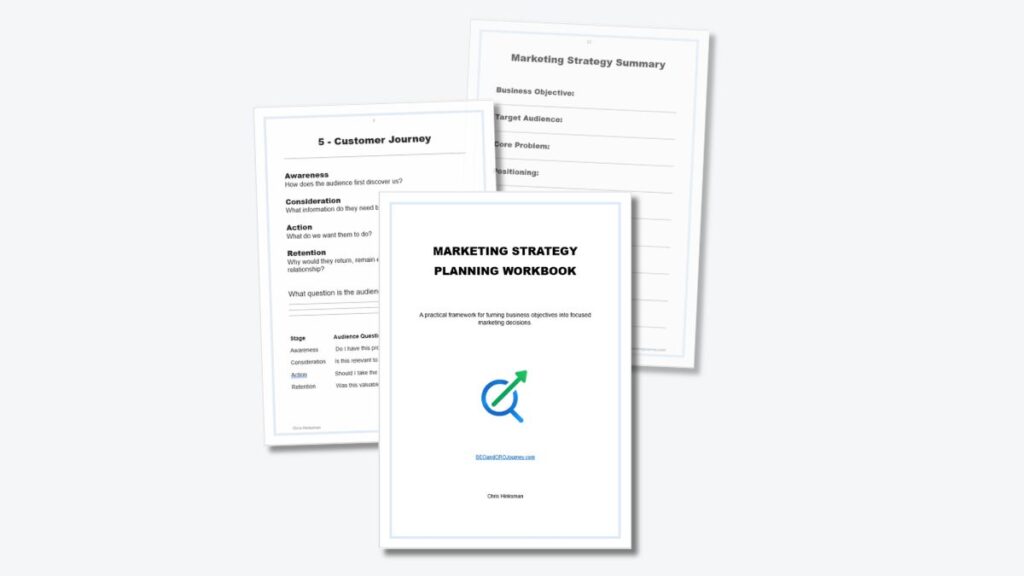
I created a practical Marketing Strategy Brief to help connect business objectives, audience understanding, positioning, customer journey, channels, content and measurement in one place.