
SEO isn’t simply about getting someone to click. It’s about understanding what they are trying to do next.
When I first started learning SEO, I thought a lot about getting pages found. Find the right keyword, optimise the page, improve the title, create useful content and hopefully Google will reward the work with more visibility and traffic.
That still matters, clearly there isn’t much point creating a great page if nobody can find it.
But over the last eight or nine months, my understanding of SEO has changed quite considerably. The more I have learned about CRO, analytics, search intent, positioning and marketing strategy, the more I have started to see search as the beginning of something rather than the end goal.
Someone searches for something because they have a question, a problem, a need or perhaps simply a curiosity. They find your page and then, they might read another article, compare different solutions, download something, return a few days later, make an enquiry or eventually buy.
Or they might leave and never come back.
That process is the customer journey, and I think understanding it is one of the things that has moved my thinking further away from simply asking, “How do I rank this page?” and towards asking, “What are we actually trying to help this person do?”
Search Isn’t The Destination
One of the things that has become much clearer to me through learning keyword research is that a search query doesn’t tell you everything about the person behind it.
Take two searches around the same subject.
Someone might search:
“What is conversion rate optimisation?”
Someone else might search:
“Best CRO agency Sydney pricing.”
They are both interested in CRO, but they are clearly not in the same place.
The first person may simply be trying to understand something they have heard about. They might be months away from doing anything about it, or they may never need a CRO service at all.
The second person is probably much further along, they may already understand the problem and are now comparing potential solutions.
This is why I have become much more interested in search intent rather than simply search volume. In my article Keyword Research: Understanding Search Intent, Not Just Search Volume, I explored the idea that the words people use can give us clues about what they are actually trying to accomplish.
That is important because SEO can sometimes become overly focused on the keyword itself.
We find a keyword, we look at the search volume and we try to rank for it.
But the more useful question is what happens once somebody searches.
What are they trying to understand?
What problem are they trying to solve?
And where might they be in their journey towards making a decision?
Those questions change the way you think about the page you are creating.
Understanding Where Someone Is In The Journey
I think about the customer journey in four broad stages: awareness, consideration, decision and retention.
They aren’t rigid boxes, and people don’t necessarily move neatly from one to the next, but they provide a useful way of thinking about what somebody needs from a business at different points.
At the awareness stage, someone may not even know exactly what the solution is, they may simply know that something isn’t working.
A business owner might search for:
“Why is my website getting traffic but no enquiries?”
They aren’t necessarily looking for an agency.
They are trying to understand the problem.
At this stage, educational content can be extremely useful. An article that explains possible causes, gives examples and helps someone understand their situation is doing a valuable job even if the visitor doesn’t make an enquiry.
That can sometimes be difficult for businesses to accept because there isn’t an immediate conversion attached to the content.
But perhaps there shouldn’t be.
If someone is still trying to understand their problem, asking them to buy something immediately may be completely out of step with where they are.
The content has another job: help them understand.
Once they understand the problem, their questions tend to change.
They might start asking what their options are, whether they should solve the problem themselves, what different approaches exist and which one might work best.
This is the consideration stage.
The content needs to change with them.
Comparison articles, detailed guides, case studies and explanations of different approaches can become more useful because the person isn’t simply asking, “What is this?”
They are asking:
“What should I do about it?”
And then eventually they may reach the decision stage.
Now the questions become much more specific.
“How much does it cost?”
“Who should I choose?”
“Does this actually work?”
“Has anyone like me used this before?”
At this point, evidence, trust, pricing, testimonials, case studies and clear explanations become much more important.
The person doesn’t necessarily need another introductory article, they need reassurance that they are making the right decision.
This Is Where Positioning Becomes Important
The customer journey doesn’t exist independently from positioning.
In fact, I think the two are closely connected.
If someone is considering several alternatives, they need to understand why a particular organisation is relevant to them.
That is one of the reasons I recently wrote How to Build Marketing Positioning Around a Real Audience.
I have become increasingly interested in the difference between what a business wants to say about itself and what the audience actually needs to understand.
A company can describe itself as innovative, customer-focused, experienced or different, but none of those statements necessarily answer the customer’s question:
“Why should I choose you?”
Good positioning gives the audience a reason to recognise relevance.
And the further somebody moves through the customer journey, the more important that becomes.
Someone in the awareness stage may simply need to understand that you understand their problem.
Someone in the consideration stage may need to understand how your approach differs.
Someone close to a decision may need evidence that you can actually deliver what you promise.
The organisation hasn’t necessarily changed, the audience’s intent has changed.
That distinction is incredibly useful when thinking about content.
SEO Gets Someone There. CRO Helps You Understand What Happens Next.
This is probably where my original interest in SEO and CRO has started to make much more sense to me.
SEO can help someone discover you, but discovery isn’t the same as action.
If somebody arrives at a page and leaves, that doesn’t automatically mean the page failed. Perhaps it answered their question completely, perhaps they weren’t ready for the next step, perhaps the content didn’t match their intent, perhaps the positioning wasn’t clear, or perhaps there was simply too much friction.
CRO makes you start asking those questions.
What did the visitor expect to find?
Did the page deliver it?
Was the next step obvious?
Was the call to action appropriate for where they were in the customer journey?
That last question is particularly important.
Imagine someone who has just discovered that they have a problem, giving them a “Book a Consultation Now” button might be premature.
A better next step might be another useful article or a downloadable guide.
Someone who has spent several weeks researching solutions may need something completely different, they might be ready for a consultation, demonstration or pricing information.
The point isn’t that one CTA is better than another.
It’s that the next action should make sense for the person who is taking it.
That is where SEO and CRO start connecting.
The Journey Doesn’t End At The Sale
The final stage I think is often overlooked is retention.
Someone becoming a customer doesn’t mean the marketing job is finished.
They still need to understand what they’ve bought, how to use it and what to expect. They may need onboarding information, support content, additional resources or reassurance that they made the right decision.
And what happens after the decision can influence what happens next.
Do they buy again?
Do they recommend you?
Do they leave a review?
Do they tell somebody else about their experience?
The customer journey therefore isn’t really a straight line that ends with a purchase.
It is closer to a relationship that continues.
This is another reason I think it is dangerous to treat SEO as simply a traffic-generation exercise. If we only measure how many people arrived, we are looking at one small part of a much bigger process.
Different Content Has Different Jobs
Thinking about the customer journey has also changed the way I look at content.
I don’t think every article needs to sell something, I don’t think every page needs to rank for a high-volume keyword and I don’t think every visitor should be presented with exactly the same message or call to action.
Content should have a purpose.
Awareness content might help somebody recognise and understand a problem.
Consideration content might help them evaluate their options.
Decision content might give them the evidence and reassurance needed to act.
Retention content might help them get more value from the decision they have already made.
That seems obvious when written down, but it is surprisingly easy for content production itself to become the objective.
Businesses can end up asking:
“How many articles did we publish this month?”
when a much better question might be:
“What part of the customer journey are we helping?”
That is a much more strategic question.
The Customer Journey Should Influence What You Measure
Once you start thinking about content in this way, measurement becomes interesting as well.
If every piece of content has a different job, why would we expect every piece to be measured in exactly the same way?
An awareness article might be successful because it attracts the right audience and encourages them to explore further.
A consideration page might be successful because people download a resource or compare different options.
A decision page might be much more directly connected to enquiries, purchases or other conversions.
This connects closely with What Should a Marketing Strategy Actually Measure?, where I explored the difference between collecting numbers and choosing metrics that actually help us make better decisions.
A page getting 10,000 visitors isn’t automatically more valuable than one getting 500.
If those 500 visitors are exactly the audience the organisation wants to reach and they take meaningful actions, the smaller number may be considerably more valuable.
Again, it comes back to understanding the journey.
You need to know what you are trying to achieve before deciding which numbers matter.
What I Understand Differently Now
This is probably the biggest change in my own thinking.
When I started learning SEO, I was fascinated by the mechanics. I wanted to understand how Google worked, how keywords influenced visibility and how pages could be optimised.
Then CRO introduced another question:
What happens when someone arrives?
And the more I have learned about marketing strategy, the broader that question has become.
Why are we trying to attract this person?
What problem are they trying to solve?
Where are they in their journey?
What do they need from us at this point?
What should happen next?
And how will we know whether what we have done actually helped?
I don’t have enormous traffic numbers or thousands of customers, and I’m not going to pretend that I do. But I do have something that has been incredibly useful throughout this process: somewhere to experiment.
The Frictionless Man and my SEO and CRO work have given me the opportunity to take what I am learning and actually put it into practice.
Sometimes the results are encouraging and sometimes they aren’t.
Sometimes the most useful outcome is discovering that an assumption I had made wasn’t particularly good.
That is part of the learning.
And I think that has gradually changed my definition of what good SEO looks like.
It isn’t simply:
“Did this page rank?”
It is increasingly:
“Did this page help the right person move one step further through their journey?”
That feels like a much more useful question.
From Search To Action
The way I think about the process now is fairly simple:
Search → Intent → Journey Stage → Content → Action → Measurement
Start with what the person is searching for.
Try to understand what they actually want to accomplish.
Consider where they are in the customer journey.
Create something that is appropriate for that stage.
Give them a sensible next step.
Then decide how you will know whether the content is doing its job.
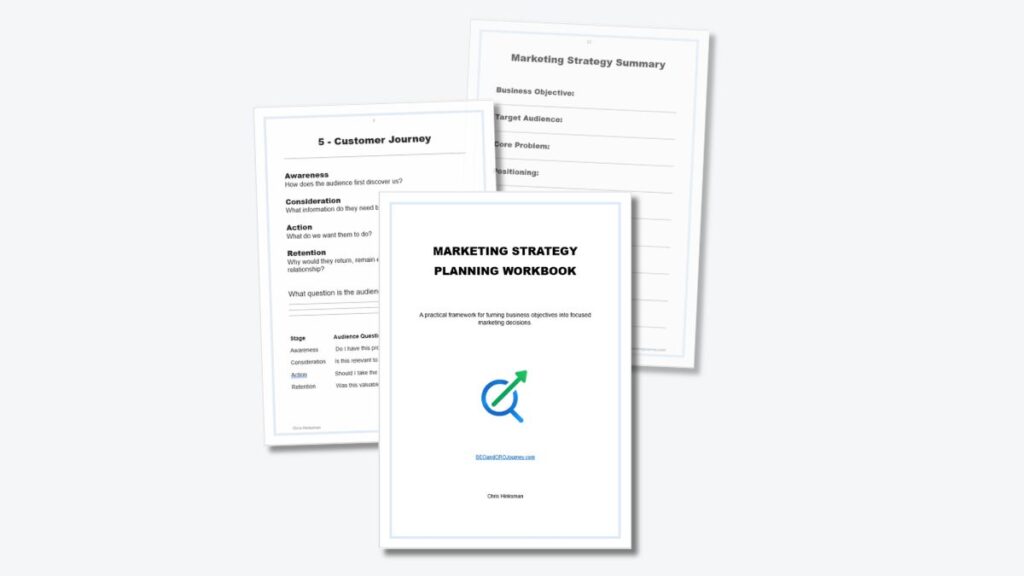
This is also why the Customer Journey section of my Marketing Strategy Planning Workbook has become important to me. It sits alongside audience, positioning, channels, content and measurement because those things shouldn’t really be considered independently.
The customer journey connects them.
Your audience has a problem.
Your positioning explains why your solution is relevant.
Your content helps them understand, evaluate and decide.
Your channels help you reach them.
And your measurement tells you whether the strategy appears to be working.
That is a much bigger picture than simply getting a page onto Google.
Final Thought
I started this journey thinking about SEO largely as a way of getting websites found.
I still think that is important.
But I now see search as the beginning of something much bigger.
Someone searches because they have a question, a problem, a need or perhaps simply a curiosity. The search result gives you an opportunity, but the click is only the beginning.
What happens afterwards depends on where that person is in their journey, what they understand already, what they need to know next and how effectively the organisation helps them move forward.
That’s why I don’t think the ultimate objective of SEO should simply be to rank pages.
The better question is what happens after someone finds you.
Because the real goal isn’t just to get someone from search to your website.
It is to understand how a real person moves from search to action, and to make that journey as useful, relevant and frictionless as possible.
Here’s to success (and fewer 404s)
Chris