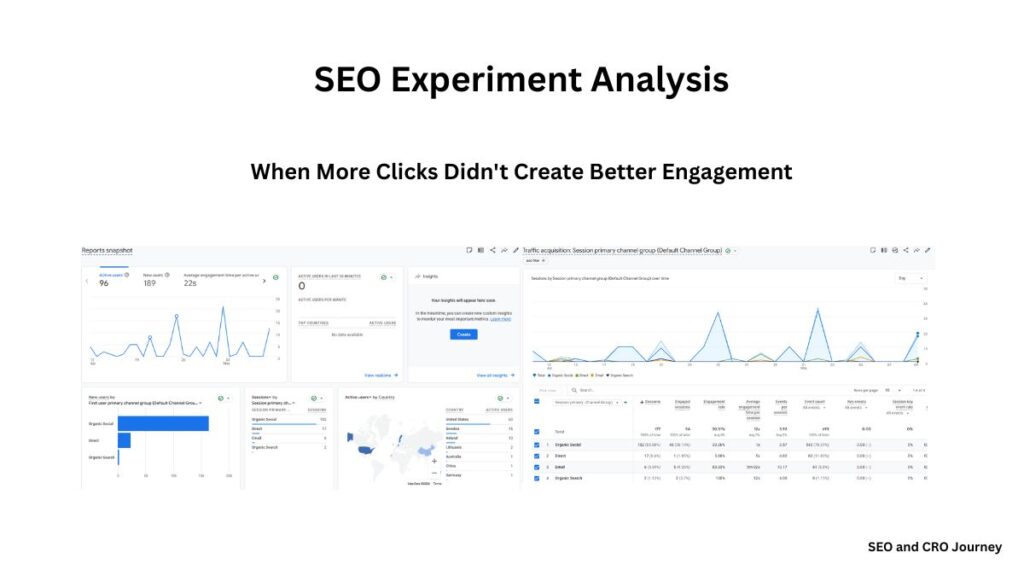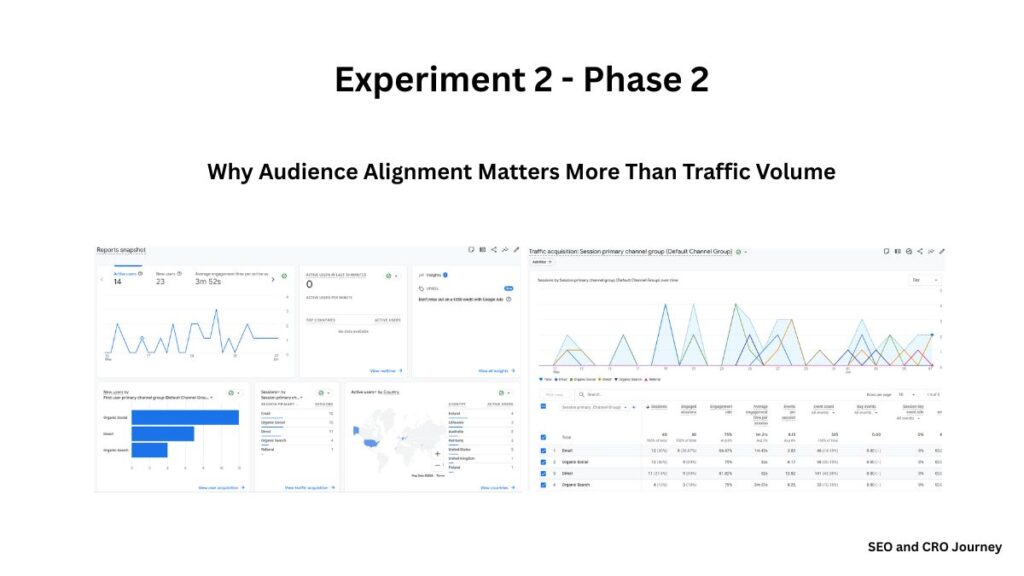

Experiment 2 forms part of The Frictionless Man Growth Strategy, where I’m documenting every experiment, lesson and adjustment while building the website in public.
When I decided to build a website from scratch, I thought I understood what success would look like.
Publish useful articles.
Learn SEO.
Watch Google gradually send visitors.
Improve what wasn’t working.
It sounded logical enough.
What I didn’t appreciate was how much of the journey would have nothing to do with SEO itself. Looking back, the technical side was often the easiest part. The difficult part was learning how to think differently. How to stay consistent when nobody appeared to be reading, how to interpret small amounts of data without jumping to conclusions and how to keep improving when the results arrived much more slowly than expected.
Experiment 2 became my attempt to document that process honestly. Rather than writing about SEO from the perspective of someone looking back after success, I wanted to record what actually happened while building The Frictionless Man in public.
Three phases later, I realised the biggest lessons weren’t about algorithms.
They were about patience, behaviour and making better decisions.
Building a Website From Scratch Begins Long Before Google Notices
One of the biggest misconceptions I had was assuming that SEO starts once your content is published.
In reality, it starts much earlier.
It starts with structure.
It starts with understanding who you’re writing for.
It starts with deciding what your website actually stands for before worrying about rankings.
When I began The Frictionless Man, there was no traffic to analyse and no rankings to celebrate. There was simply an empty website and an idea I believed was worth developing.
That period taught me something I don’t think enough people talk about.
Publishing the first few articles feels strangely uncomfortable because there is almost no external feedback. You’re creating content for an audience that doesn’t exist yet, trusting that consistency will eventually be rewarded.
That’s much harder psychologically than learning SEO itself.
If you’d like to see how the project began, read Experiment 2 – Phase 1: Building the Foundations, where I focused on creating the technical and structural foundations before worrying about traffic.
Consistency Changed My Thinking More Than Any SEO Course
Somewhere around the middle of the experiment I noticed my priorities beginning to change.
Initially, every article felt like an attempt to rank.
Eventually, every article became an attempt to help someone.
That subtle shift completely changed the way I approached writing.
Instead of asking whether Google would understand the article, I started asking whether Mark—the audience I’d created for The Frictionless Man—would genuinely find it useful.
Ironically, I think that mindset produced better SEO.
One thing I didn’t appreciate when I decided to build a website from scratch was how important consistency would become. Publishing every week gradually changed both my writing and the way I approached SEO. Writing consistently revealed something else, improvement rarely arrived because I learned one brilliant new technique. It happened because every article taught me something small.
One headline worked better than another.
One introduction held attention more effectively.
One structure felt easier to read.
Those small improvements accumulated quietly until the writing itself became noticeably stronger.
I explored this shift further in Experiment 2 – Phase 2: Creating Consistency Before Growth, where consistency became more valuable than chasing quick results.
Traffic Turned Out To Be The Wrong Thing To Measure
Like most people building a website from scratch, I became slightly obsessed with Google Analytics.
I checked traffic far too often.
Every visitor felt significant.
Every quiet day felt disappointing.
Eventually I realised I was measuring the wrong thing.
Traffic tells you someone arrived, engagement tells you they stayed.
During Phase 3, The Frictionless Man attracted only a small number of active users, on paper, those numbers looked almost insignificant.
What surprised me was the average engagement time.
Visitors weren’t disappearing after a few seconds. …. They were reading!
Some spent more than six minutes on the site.
That single metric completely changed how I viewed progress.
I’d rather have fifteen genuinely engaged readers than hundreds who leave immediately because the content failed to meet their expectations.
It reminded me that numbers only become meaningful when you understand the behaviour behind them.
I think this is an important lesson for anyone trying to build a website from scratch, traffic usually arrives much later than confidence.
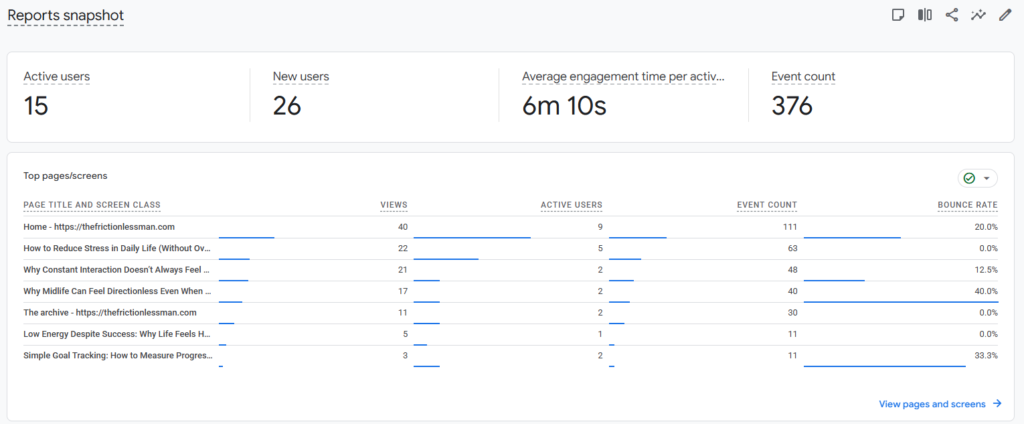
Those observations became the focus of Experiment 2 – Phase 3: Understanding Behaviour, where I looked beyond traffic to understand how people were actually interacting with the website.
Internal Linking Became One Of My Biggest Missed Opportunities
If I could restart the website tomorrow, this is probably where I’d make the biggest change.
The first twenty articles were largely written as individual pieces.
At the time, that made sense because there wasn’t much content available to connect together.
As the website grew, however, something became obvious.
Readers shouldn’t finish an article wondering where to go next.
They should naturally continue exploring another related idea.
That isn’t simply good SEO, it’s good communication.
If someone finishes reading about decision fatigue, there’s a good chance they’ll also find value in an article about reducing mental clutter or creating a weekly reset. The responsibility for making those connections sits with me, not the reader.
Over the past few weeks I’ve spent almost as much time improving older articles as writing new ones. Adding contextual internal links has gradually transformed the site from a collection of articles into something that feels much closer to a connected library.
That feels like a much better experience for everyone involved.
SEO Is Really About Understanding Human Behaviour
This was probably the biggest surprise of the entire experiment.
The more I learned about SEO, the less technical it became.
Keywords still matter.
Internal links matter.
Site speed matters.
But beneath all of those sits something much more fundamental.
People.
Every search begins because somebody is trying to solve a problem.
Every click represents curiosity.
Every page view becomes a tiny psychological decision.
Will I continue reading?
Does this answer my question?
Should I trust this website?
The more I focused on those questions, the more SEO and behavioural psychology started to overlap.
Ironically, that’s exactly the philosophy The Frictionless Man was built around.
Reducing friction isn’t just useful for everyday life.
It’s useful for websites too.
Five Things I’d Do Differently If I Started Again
Looking back, there are several things I’d change immediately if I had to build a website from scratch today.
I’d build topic clusters much earlier rather than treating articles as isolated pieces.
I’d start adding internal links almost from the beginning instead of waiting until the content library felt established.
I’d spend less time checking analytics and more time improving existing content.
I’d worry far less about traffic during the first few months because meaningful patterns take time to emerge.
Most importantly, I’d trust consistency much sooner.
None of those lessons came from reading another SEO guide …. They came from doing the work!
The Biggest Lesson Wasn’t Technical
Experiment 2 wasn’t really an SEO experiment.
At least, not in the way I expected.
It became an experiment in patience.
Building a website from scratch means working for long periods without obvious rewards.
Some weeks nothing appears to happen.
Google indexes another page almost unnoticed.
A stranger leaves a comment.
Someone discovers your website through search.
A LinkedIn connection request arrives from someone you’ve never met.
Those moments seem small individually.
Together, they quietly confirm that progress is happening.
Not dramatically.
Gradually.
And that’s probably how most sustainable growth works.
Looking Ahead
Experiment 2 answered the question I originally set out to explore.
Can consistent publishing create the foundations of a genuine website?
I believe the answer is yes.
The next question feels even more interesting.
Now that the content exists, can strengthening the relationships between those articles improve how both readers and search engines experience the website?
That becomes the focus of Experiment 3: Building Topical Authority.
Rather than simply publishing more content, the next stage will concentrate on improving content architecture, strengthening internal linking, developing clearer topic clusters and observing how those changes influence both user behaviour and organic performance over time.
I suspect the lessons will be just as valuable as the results.
Final Thoughts
When I began this journey, I thought learning SEO meant understanding Google.
Three phases later, I think it means understanding people.
Algorithms change.
Best practice evolves.
New tools appear almost every month.
Human behaviour is far more consistent.
People still want clear answers.
They still appreciate useful content.
They still respond to experiences that feel simple rather than complicated.
Building a website from scratch has taught me plenty about SEO, but it has taught me even more about patience, curiosity and continuous improvement. If I ever decide to build another website from scratch, these are the lessons I’ll carry with me from day one.
More importantly, it’s taught me how small, thoughtful improvements gradually become something much bigger than a collection of articles.
The goal was never to build the biggest website.
It was always to build one that became a little more useful every week.
Here’s to success (and fewer 404s)
Chris