Over the past several weeks, I’ve been continuing a behavioural marketing experiment on a small website I built called The Frictionless Man — a project originally created to explore how messaging, psychology, and content structure influence user behaviour online.
The first phase of the experiment focused primarily on click behaviour. I tested different Facebook hook styles to see whether changes in framing influenced traffic patterns and engagement. Some approaches clearly generated stronger responses than others, particularly posts that used sharper emotional framing or more personal positioning.
At first glance, that felt like progress.
Traffic increased, sessions spiked more consistently and organic social traffic became the dominant acquisition channel. Behaviourally, the audience was responding.
But once I stepped back and reviewed the broader analytics picture, something more interesting started to appear.
The stronger the hooks became, the less stable engagement appeared after the click.
And that shifted the experiment entirely.
The Goal of Experiment 2
The second phase of this project was never really about generating traffic volume. The website itself is still relatively new, with a very small audience and no paid promotion behind it. The objective was behavioural observation rather than scale.
What I wanted to understand was something slightly deeper:
How much does messaging alignment influence engagement quality once visitors actually arrive on the page?
In other words:
It’s relatively easy to generate curiosity online, but does the expectation created by a hook match the experience users encounter after clicking?
That question sits much closer to CRO and behavioural psychology than traditional content marketing, and it became the central focus of this phase of the experiment.
The Structure of the Experiment
To keep the testing environment relatively controlled, I tried to minimise unnecessary variables.
The Frictionless Man continued publishing articles aimed at the same audience persona — a midlife professional male audience dealing with mental load, cognitive fatigue, career pressure, and low-level stress accumulation.
The articles remained consistent in tone:
- calm
- reflective
- psychologically practical
- low-drama
- systems-oriented
Traffic was driven primarily through Facebook posts using different psychological framing styles and hook structures.
Importantly, I wasn’t changing website design, running paid ads, or introducing major SEO changes during the experiment. The goal was to isolate how messaging and framing influenced behavioural response patterns.
The experiment gradually shifted from:
“How do we attract attention?”
Towards:
“What happens once attention arrives?”
That distinction ended up mattering far more than I expected.
The Early Signals Looked Positive
At an overview level, the experiment initially appeared encouraging.
Traffic patterns showed clear spikes in activity corresponding with post publishing schedules, and organic social traffic became the dominant acquisition source throughout the testing period.
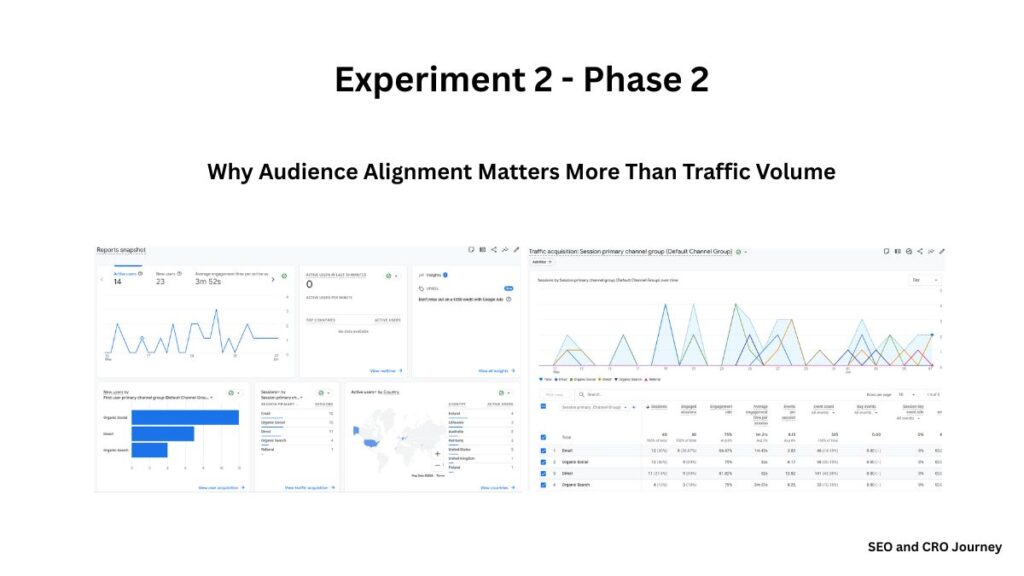
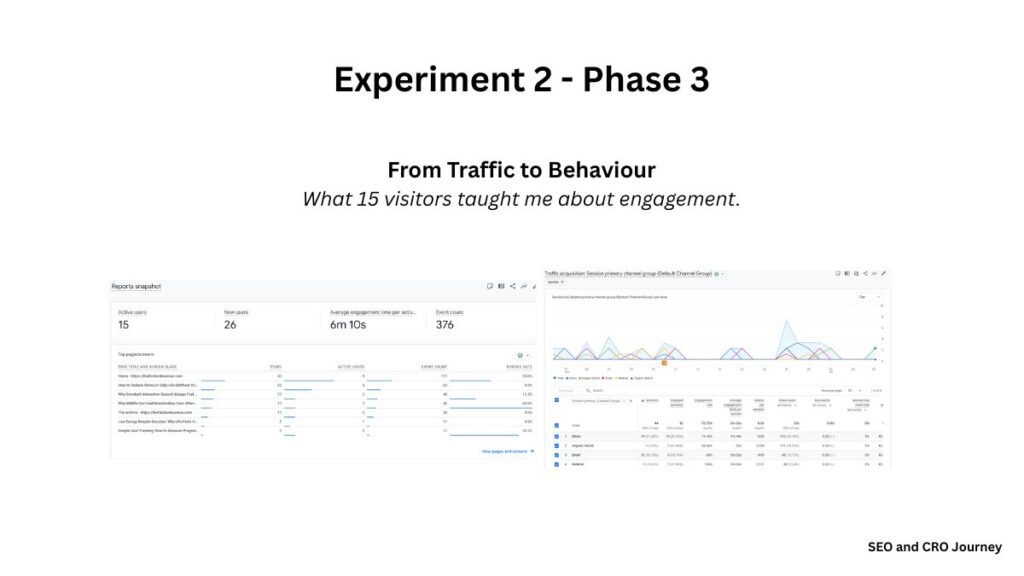
The first screenshot below captures the broader behavioural pattern across the experiment period.
The spikes themselves are important because they demonstrate that messaging changes were influencing user behaviour in measurable ways. Certain posts clearly generated more curiosity and more immediate response than others.
However, the deeper insight wasn’t hidden in the spikes themselves.
It was hidden in what happened afterwards.
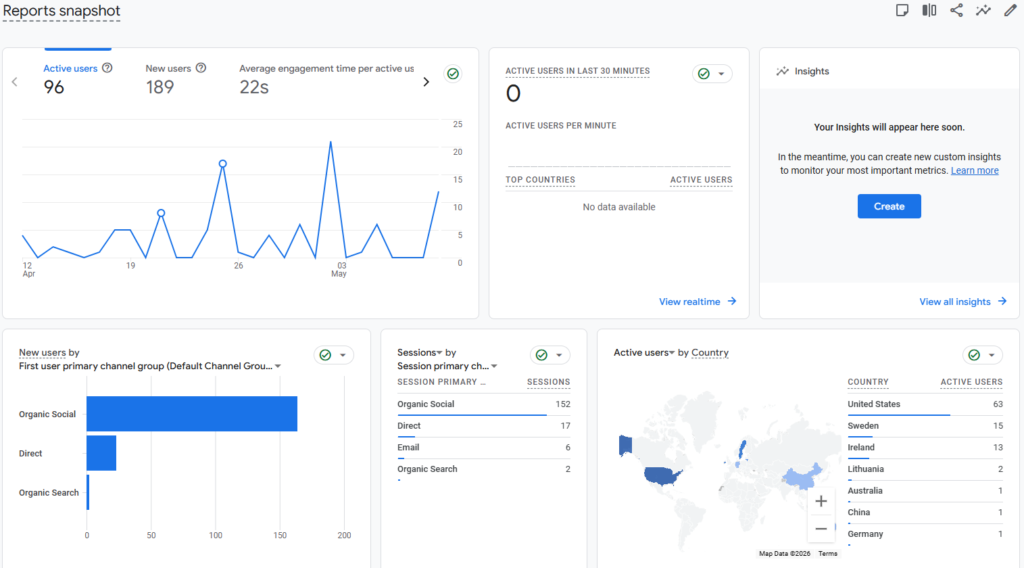
One metric immediately stood out during analysis:
Average engagement time per session remained unexpectedly low.
At first I assumed this might simply be a measurement issue inside GA4. Small websites often generate inconsistent engagement data because session tracking can become unreliable with low traffic volumes, rapid exits, or fragmented event timing.
But when the same pattern appeared repeatedly across multiple weeks, it became harder to ignore.
Traffic was increasing.
Engagement quality wasn’t increasing alongside it.
When Better Hooks Create Worse Alignment
This was the point where the experiment became significantly more interesting.
Initially, I had viewed stronger hooks as an obvious improvement. Sharper framing created clearer behavioural spikes, which suggested stronger emotional resonance with the audience.
But over time I started questioning whether the hooks were actually outperforming the landing experience itself.
The Facebook posts created immediate emotional tension:
- exhaustion
- identity pressure
- hidden mental fatigue
- midlife friction
- cognitive overload
The articles themselves, however, were intentionally calmer and more reflective in tone, they were designed to slow the reader down rather than intensify emotional urgency.
That mismatch may have created a behavioural disconnect.
The hook created emotional momentum.
The article invited slower reflection.
Some users likely arrived expecting immediate emotional payoff, only to encounter a more measured pace than anticipated.
From a behavioural perspective, that’s fascinating.
Because it suggests the experiment was no longer measuring click behaviour alone, it was now exposing the relationship between expectation and experience.
And that relationship is essentially what CRO is about.
At first, I assumed stronger hooks would naturally lead to stronger engagement. Looking back, that assumption now feels too simplistic. A hook doesn’t just attract attention; it shapes expectation. If the emotional tone of the click differs significantly from the emotional tone of the content, engagement can break down before the reader fully settles into the article.
The Analytics Became More Valuable Than The Traffic
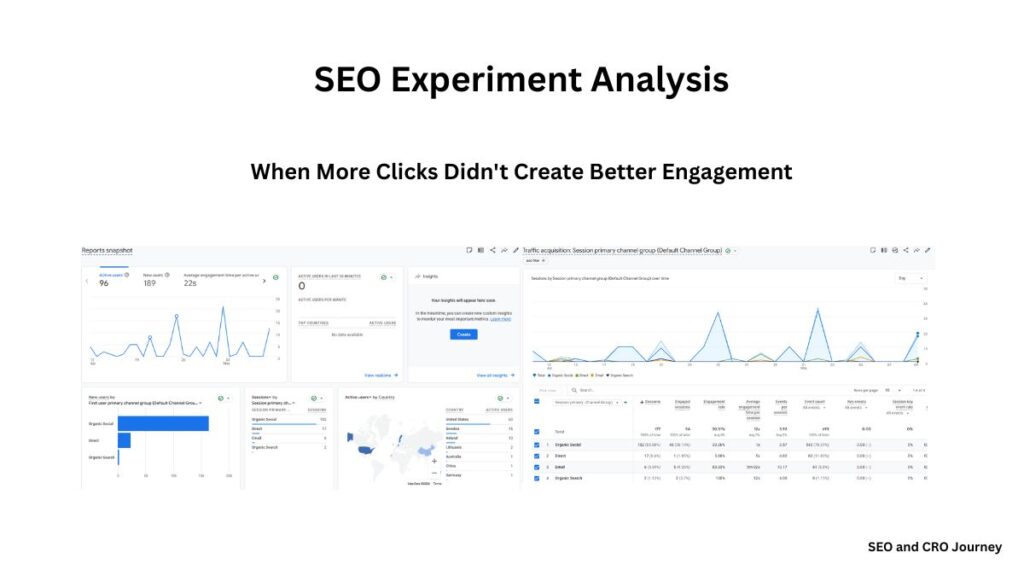
The second overview screenshot reinforced this further.
Traffic volume continued increasing throughout the period, with Organic Social driving the overwhelming majority of sessions.
At face value, this could easily be interpreted as a positive growth signal.
But again, the engagement patterns complicated the picture.
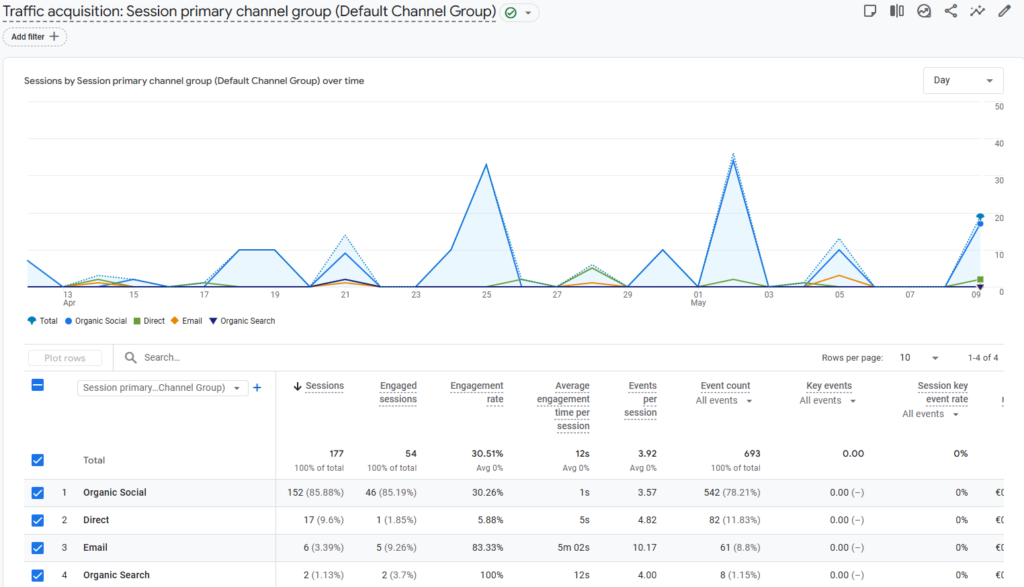
Average engagement time per session remained extremely low despite increased traffic activity.
Rather than viewing this as failure, I started seeing it as evidence of something more useful:
Acquisition and retention are separate psychological problems.
Generating curiosity does not automatically create sustained engagement.
And in many ways, that feels obvious once you say it out loud. But seeing the pattern emerge inside your own data changes how you think about marketing entirely.
It forces you to move beyond vanity metrics and ask harder questions:
- What expectation did the messaging create?
- Did the landing experience satisfy that expectation?
- Was the audience genuinely aligned?
- Did curiosity convert into relevance?
- Was the traffic emotionally compatible with the content itself?
Those questions feel significantly more important than simple traffic numbers.
What This Changed In My Thinking
Before running these experiments, I probably viewed marketing in a fairly linear way.
Good messaging generated traffic.
Good SEO generated visibility.
Better optimisation improved performance.
But experimentation has made the process feel much more behavioural than technical.
Messaging is not just communication.
It creates psychological expectation.
And once someone clicks, they are unconsciously evaluating whether the experience matches the promise implied by the framing that brought them there.
That changes how I now think about:
- article introductions
- pacing
- emotional continuity
- behavioural sequencing
- audience fit
- content structure
The experiment also highlighted something else that feels increasingly important:
Small wording changes influence not just clicks, but the type of visitor being attracted.
That distinction matters enormously.
Because not all traffic is equally valuable.
Some hooks generate broad curiosity.
Others attract smaller but more behaviourally aligned audiences.
Those are very different outcomes.
Why This Experiment Matters To Me
One of the reasons I built SEOandCROJourney.com alongside The Frictionless Man was to document practical learning rather than simply study marketing theoretically.
There is a major difference between understanding concepts intellectually and observing behavioural patterns in real-world environments.
Running experiments forces clarity.
You stop asking:
“What is best practice?”
And start asking:
“What is actually happening here?”
That shift changes how you interpret marketing entirely.
It becomes less about tactics and more about systems, psychology, expectation, and behaviour.
Experiment 2 reinforced that strongly.
What initially looked like a traffic experiment gradually became an audience alignment experiment instead.
And honestly, that feels much more valuable.
What Happens Next
This article is the first part of a three-part experiment series documenting the evolution of this project.
The next phase will focus more directly on post-click engagement itself:
- article opening structure
- emotional continuity
- expectation alignment
- behavioural pacing
- content retention
Because at this point, the most interesting question is no longer:
“How do you generate clicks?”
It’s:
“How do you sustain attention once you have it?”
That feels like the point where SEO, CRO, and behavioural psychology genuinely begin intersecting.
And for me, that’s where marketing starts becoming much more interesting than traffic alone.
Here’s to success (and fewer 404s)
Chris