
When I first started learning SEO, I imagined progress would feel far more visible than it actually does. The process seemed fairly logical in theory: publish a page, optimise the structure properly, improve the title, submit the URL to Google Search Console, and gradually traffic would begin increasing.
What I didn’t expect was how quiet the entire process feels in reality.
You can spend hours improving a page and then see absolutely nothing happen afterwards. No traffic spike, no dramatic ranking movement, no obvious validation that the work mattered at all. Coming from professional environments where effort and outcome are often closely connected, I found this surprisingly uncomfortable at first.
What Google Search Console gradually taught me is that SEO operates on a very different timeline than most people expect.
Before using Search Console regularly, I underestimated how incremental SEO really is. From the outside, most SEO conversations focus on outcomes, rankings, clicks, impressions, and traffic growth. But once you start spending time inside Search Console, you begin seeing the slower reality underneath those outcomes.
Pages appear gradually, queries emerge slowly, impressions arrive before clicks, rankings fluctuate constantly, and nothing moves in a perfectly linear way.
One week a page starts appearing for several searches, the next week those impressions disappear, and then later they return again in slightly different positions. Initially this felt frustrating because I expected optimisation to create clearer cause-and-effect relationships.
Instead, Search Console showed me that SEO is often less about immediate outcomes and far more about long-term accumulation.
One of the most interesting moments early on was seeing impressions appear before any meaningful traffic existed. At first glance, impressions can seem insignificant because they do not necessarily represent visits. But psychologically they changed something important for me because they proved the page existed within Google’s awareness.
That sounds like a small thing, but when you are learning SEO from scratch, those small signals matter. A page appearing for even a handful of searches means:
- indexing is happening
- relevance is being tested
- Google is beginning to understand what the content is about.
Search Console helped me realise that SEO growth often begins invisibly long before it becomes measurable in obvious ways.
That shift changed my expectations significantly.
One thing I didn’t expect was how useful Search Console would become for managing emotional reactions to SEO itself. Without data, it is easy to assume nothing is happening or that the strategy simply is not working. But Search Console reveals movement long before success becomes externally visible.
A page may slowly gain impressions, begin appearing for broader keyword variations, or improve average positioning over time. Those smaller signals create perspective. Instead of emotionally reacting to short-term traffic fluctuations, I started paying more attention to directional movement across longer periods.
That mindset shift probably matters more than any individual metric.
Because SEO punishes impatience constantly.
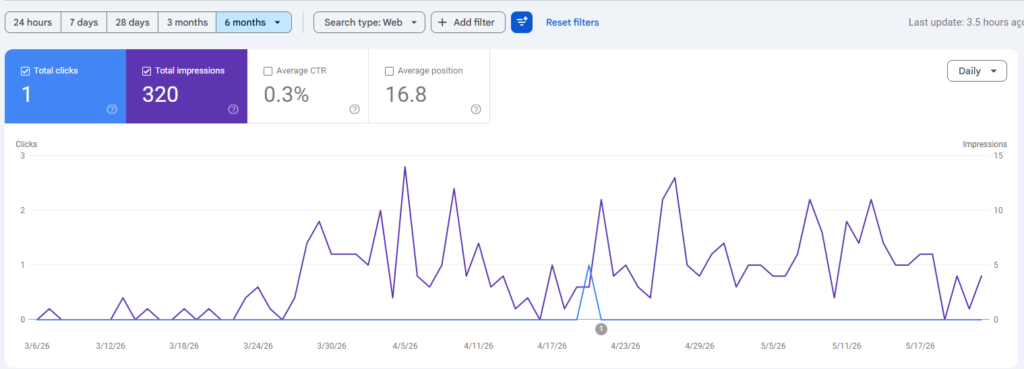
The above six-month Search Console snapshot from The Frictionless Man was one of the first moments I properly understood the difference between visibility and traffic.
While clicks remained extremely low, impressions steadily increased over time, suggesting Google was beginning to crawl, test, and surface content across more searches.
What surprised me most was how gradual the process felt. SEO progress wasn’t linear or dramatic, it looked more like slow behavioural validation happening quietly in the background.
Another thing Search Console taught me is that publishing content and creating discoverability are not the same thing, writing an article does not guarantee indexing, visibility, or rankings. Google still has to:
- crawl the page
- interpret the content
- understand the intent behind it
- compare it against competing pages
- decide whether it deserves visibility at all.
That process is far more dynamic than I originally realised.
Some pages indexed quickly, others took far longer. Some articles began appearing for searches I never intended to target directly. Search Console exposed how unpredictable search behaviour can actually be, and strangely that unpredictability made SEO feel more interesting rather than less.
One of the more fascinating parts of Search Console is seeing the actual phrases people use to discover content, often they are not the keywords you expected. A page written around one core idea may begin generating impressions for adjacent emotional or behavioural themes instead.
That taught me something important about content: people search according to internal experience, not perfect keyword logic.
Someone rarely searches for something like “decision fatigue framework.” More often they search for phrases closer to lived experience, “why does everything feel mentally exhausting lately?” Those differences matter because they reveal how real people frame problems internally.
Search Console started feeling less like a ranking tool and more like a window into audience psychology.
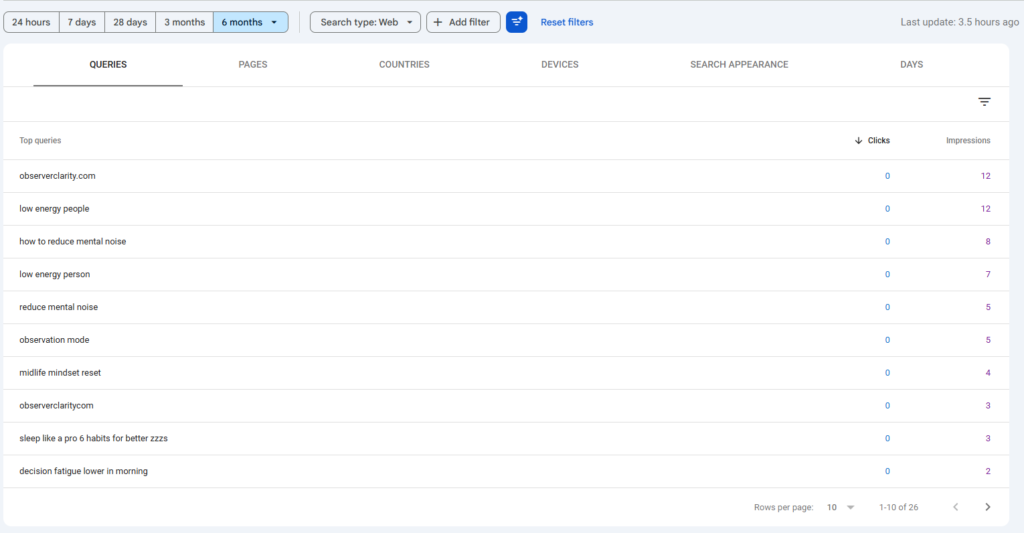
The above query data from Search Console, from The Frictionless Man, was one of the first moments I realised SEO is less about sudden traffic spikes and more about gradual topical association.
While impressions remained relatively low, Google was already beginning to connect the site with recurring behavioural and psychological themes, such as mental clarity, decision fatigue, low energy, and midlife mindset shifts.
The interesting part wasn’t the lack of clicks yet, it was the fact the content was starting to appear for the kinds of searches the site was intentionally built around. Early growth is about helping Google slowly understand what your website consistently talks about over time.
What surprised me most while learning Google Search Console was how incomplete SEO data feels without behavioural context. Impressions and clicks explain how people find a page, but they reveal very little about what happens after someone arrives. That distinction became much clearer once I started spending more time inside Google Analytics 4, particularly around engagement patterns and visitor behaviour. I wrote more about that learning process in What Google Analytics 4 Changed About How I Think About Behaviour, because increasingly the two platforms feel less separate and more like different views of the same human decisions
The longer I have used Google Search Console, the less interested I have become in shortcut-style SEO thinking. The data consistently reinforces something much simpler: structure matters, consistency matters, clarity matters, and topical alignment matters. Not dramatically or instantly, but gradually over time.
SEO now feels much closer to system-building than quick optimisation tricks, and honestly I find that reassuring because sustainable growth usually comes from foundations rather than spikes.
Google Search Console changed how I think about SEO because it forced me to confront the gap between effort and visible outcome. At first that gap feels uncomfortable but over time it becomes clarifying.
SEO is quieter than most people expect, slower than most people want, and far more cumulative than it initially appears. But Search Console also reveals something encouraging: small signals matter.
A page appearing for new queries matters, incremental impressions matter and gradual indexing matters. Because underneath those quiet movements, foundations are forming.
And increasingly, I think good SEO resembles good strategy more generally, consistent structure, patient iteration, and the willingness to keep improving things before visible rewards appear.
Here’s to success (and fewer 404’s)
Chris