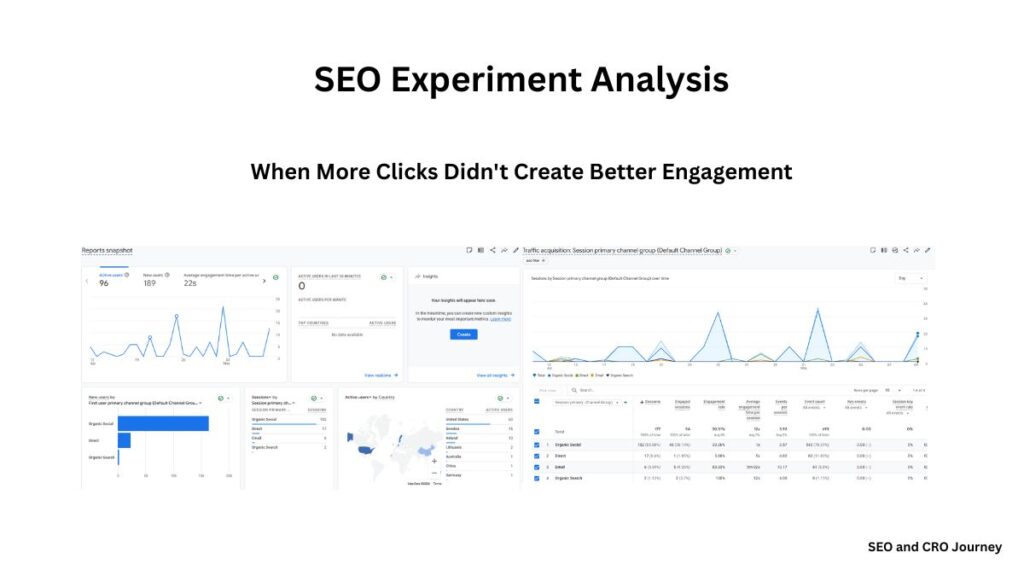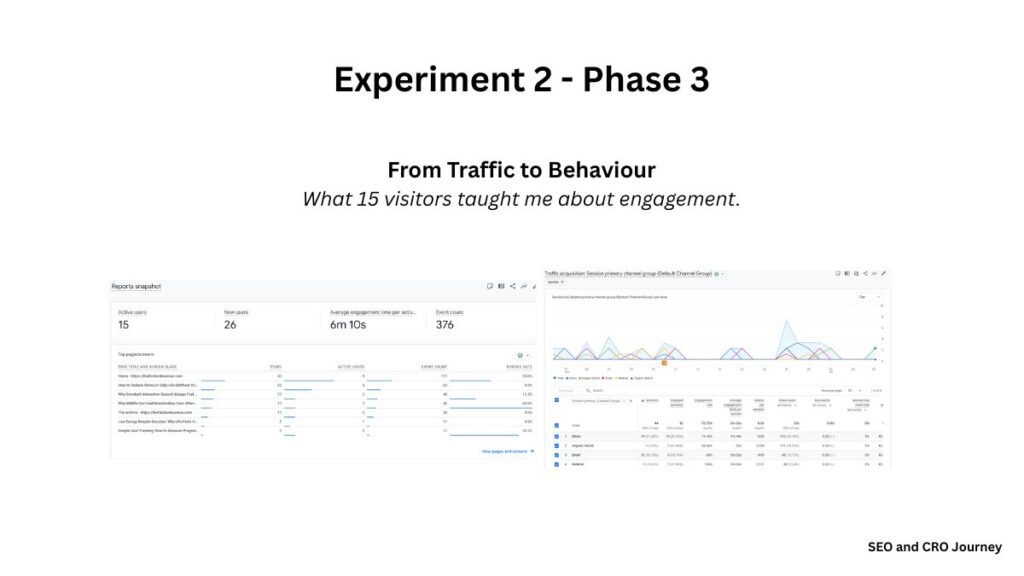
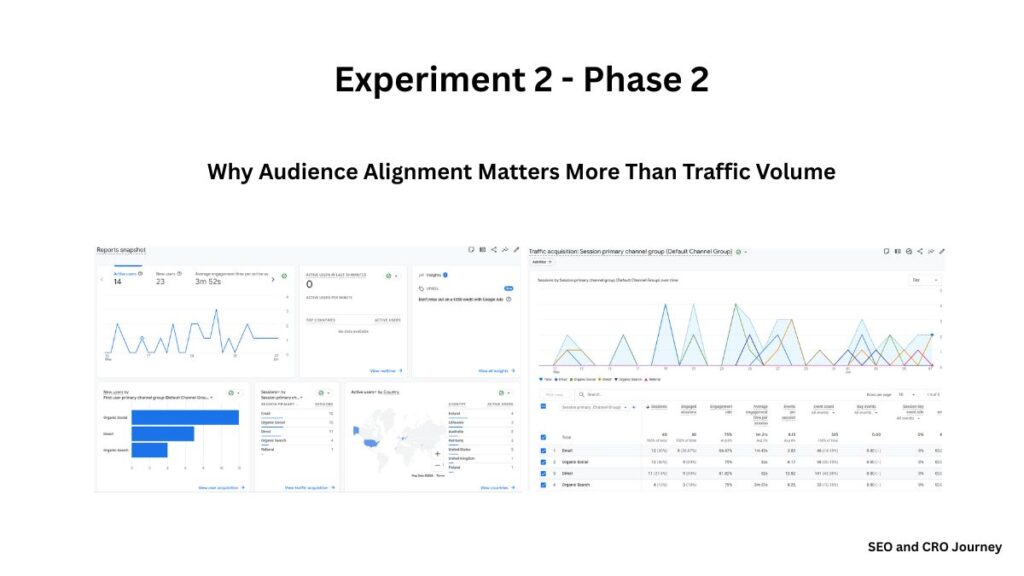
When I started Experiment 2, I thought I was testing engagement.
At least, that was the intention on paper.
The goal was to understand what happened after somebody clicked. Could small changes to content structure, pacing, and article introductions improve engagement quality once visitors arrived on the page?
What I didn’t expect was for the experiment to reveal something far more interesting.
The deeper insight wasn’t about engagement at all.
It was about audience alignment.
Over the past several weeks, I’ve been running a series of behavioural marketing experiments across: The Frictionless Man. The objective has never been scale. Traffic volumes remain small and there has been no paid promotion involved. Instead, the purpose has been to observe behaviour in a relatively controlled environment and see what patterns emerge.
Sometimes those patterns confirm what you expect.
Sometimes they don’t.
This was one of the latter.
Looking Beyond Traffic
Like many marketers, I still feel a small sense of satisfaction when traffic increases.
More visitors usually feels like progress.
For a long time, that was how I interpreted website performance. If more people were arriving, things must be moving in the right direction.
But one of the benefits of running experiments is that they force you to look more closely.
During the second phase of this project, I began spending less time looking at visitor numbers and more time examining how different audiences behaved once they arrived.
That’s where things became interesting.
At first glance, the traffic acquisition report appeared fairly ordinary.
Visitors were arriving through several channels:
- Organic Social
- Organic Search
- Direct traffic
The overall numbers were small, which is exactly what you’d expect from a relatively new website.
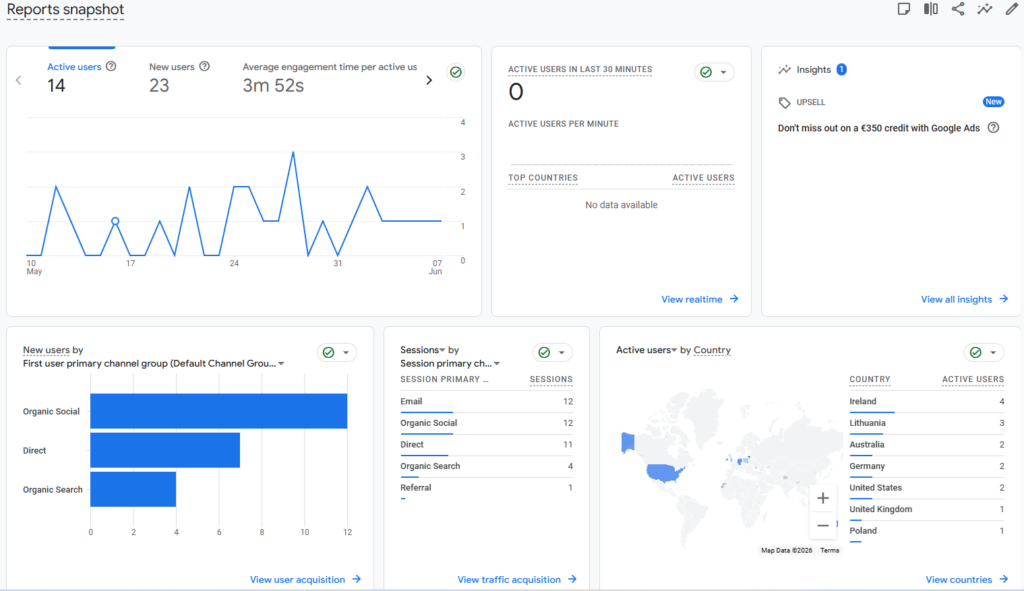
What caught my attention wasn’t the traffic volume.
It was the difference in behaviour between channels.
Not All Visitors Behave The Same
One assumption that’s easy to make in marketing is that traffic is traffic.
A visitor arrives.
A session is recorded.
A page is viewed.
Job done.
But behavioural data rarely works that neatly.
When I looked at engagement time by acquisition source, the pattern became difficult to ignore.
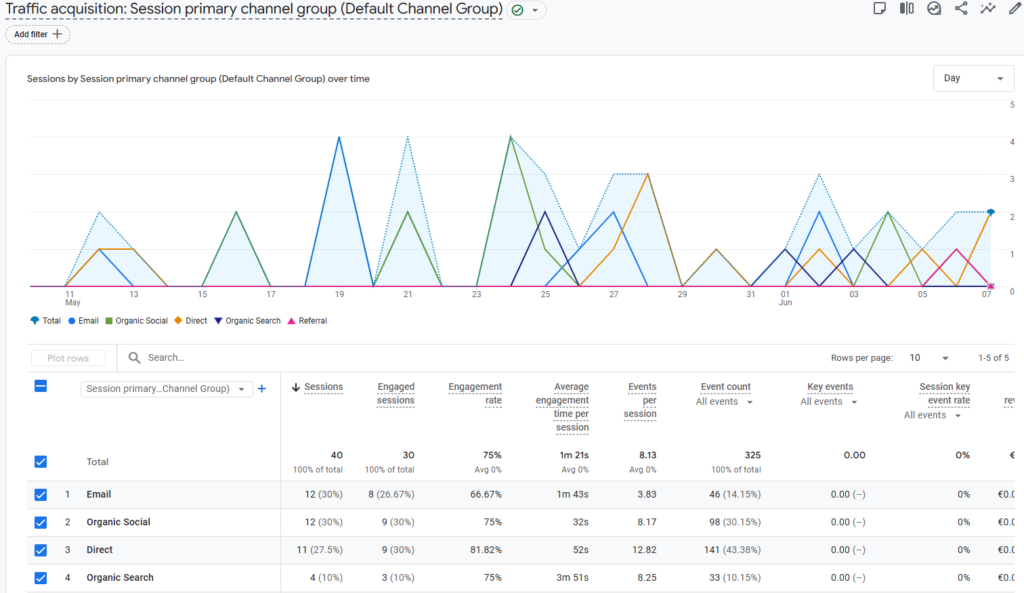
Organic Social was generating a similar number of sessions to other channels, but engagement time was relatively low.
Organic Search, on the other hand, was producing far fewer visits.
Yet those visitors stayed significantly longer.
What surprised me most wasn’t simply that search visitors stayed longer, it was the scale of the difference. Organic Search generated only a fraction of the traffic produced by Organic Social, yet average engagement time was several times higher. The sample size remains small, but the behavioural signal is difficult to ignore. Fewer visitors appeared substantially more aligned with the content itself.
The contrast wasn’t dramatic enough to make sweeping conclusions, but it was consistent enough to raise an important question:
Why were search visitors behaving differently?
The answer, I suspect, comes back to intent.
Someone arriving from Facebook is often responding to curiosity.
Someone arriving from Google is often looking for a solution.
Those are very different psychological starting points.
The search visitor already has a problem they are trying to solve.
The social visitor may simply be interested enough to click.
That distinction changes everything.
This builds directly on observations from the previous phase of the experiment, where stronger messaging appeared to generate more clicks but not necessarily stronger engagement. In many ways, that article raised the question that Phase 2 began answering: if traffic increases, are we attracting the right audience in the first place?
Read: More Clicks Didn’t Create Better Engagement: What Experiment 2 Revealed About Audience Alignment
Audience Alignment Versus Attention
One of the recurring themes throughout these experiments has been the relationship between attention and engagement.
Initially, I viewed them as closely connected.
If a message generated attention, engagement would naturally follow.
The reality appears more complicated.
Attention can be created relatively easily.
Alignment is much harder.
A strong hook can attract clicks.
A compelling headline can increase curiosity.
An emotionally resonant social media post can generate interest.
But none of those things guarantee that the person arriving is the right audience for the content itself.
That’s where audience alignment becomes important.
Alignment occurs when the expectation created before the click matches the experience encountered afterwards.
The visitor arrives expecting one thing.
The content delivers that thing.
Behaviour improves naturally because the audience and the message are compatible.
When that compatibility is missing, engagement often suffers regardless of how effective the initial hook may have been.
What Search Traffic Might Be Telling Me
One of the more encouraging findings from this phase was the behaviour of organic search visitors.
There weren’t many of them.
But the visitors who did arrive through search appeared willing to spend more time reading.
That matters because search traffic often represents a different type of intent.
The user has actively chosen to look for something.
They’ve identified a problem, typed a query, reviewed options, and selected a result.
In many cases, they arrive already motivated.
That’s a very different behavioural context than somebody scrolling through social media while waiting for a coffee or standing in a supermarket queue.
The more I thought about it, the more it reinforced a lesson that seems increasingly important:
The source of attention often influences the quality of engagement.
Not all clicks are equal.
Not all visitors are equal.
And not all traffic sources attract the same audience.
The Experiment Became More Valuable Than The Numbers
One thing I’ve enjoyed about documenting these experiments publicly is that they continually challenge assumptions I didn’t realise I was making.
When this project started, I probably would have focused on whichever channel delivered the most traffic.
Now I’m far more interested in understanding which channel delivers the most aligned visitors.
That’s a subtle but important difference.
Traffic volume tells you how many people arrived.
Audience alignment tells you how relevant those people were once they got there.
From a CRO perspective, that distinction is enormous.
Because optimisation isn’t really about attracting everyone.
It’s about attracting the people most likely to engage meaningfully.
The experiment reinforced that principle more clearly than any marketing book I’ve read.
What This Changes Going Forward
The next phase of the project will continue exploring post-click behaviour, particularly around article structure, expectation alignment, and content retention.
But this phase has already influenced how I think about acquisition.
Rather than asking:
“How do I get more traffic?”
I’m increasingly asking:
“How do I attract more of the right traffic?”
Those questions sound similar.
They’re not.
One focuses on quantity.
The other focuses on relevance.
And relevance is usually where meaningful engagement begins.
Final Thought
The most useful lesson from this phase wasn’t that traffic increased or decreased.
It wasn’t that one channel outperformed another.
It was recognising that visitor intent matters more than I previously appreciated.
The same article can produce completely different behavioural outcomes depending on how people arrive.
That insight feels increasingly important because modern marketing often encourages us to chase attention at all costs.
But attention alone doesn’t create engagement.
Alignment does.
And if these experiments have taught me anything so far, it’s that the gap between attention and alignment may be one of the most important things marketers can learn to understand.
Heres’ to success (and fewer 404s)
Chris