
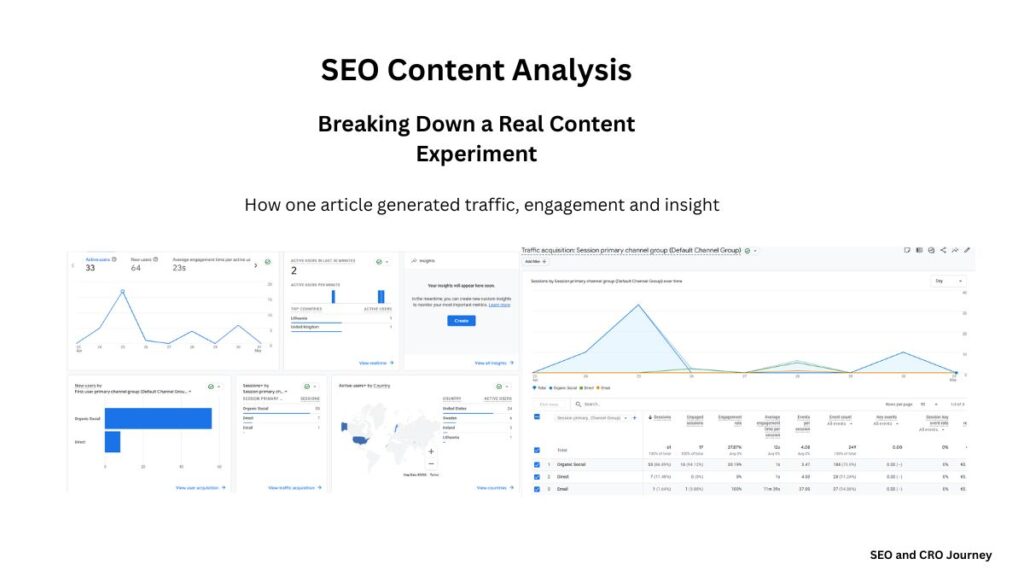
When I first started building The Frictionless Man, I assumed the biggest challenge would be visibility.
Learning SEO felt like learning how to attract attention. Keywords, indexing, impressions, rankings, and internal links, all of it seemed connected to one central idea: getting people onto the website.
But over time, I realised something more interesting was happening …. Traffic was only part of the story.
Some articles generated impressions but very little engagement while others attracted smaller audiences but created noticeably stronger behavioural signals. Certain headlines quietly resonated while others disappeared almost immediately, even when the writing quality felt similar.
One article in particular made me start paying much closer attention to behaviour rather than visibility alone:
Low Energy Despite Success: Why Life Feels Harder in Midlife
What surprised me was not simply that the article performed relatively well compared to others on the website, it was why it appeared to resonate.
The article became less of an SEO exercise and more of a behavioural case study.
Why This Article Performed Differently
The topic itself sits in an interesting psychological space.
People rarely search directly for phrases like “mental overload in midlife” or “why success feels mentally exhausting.” But many people are quietly experiencing those emotions internally.
That distinction matters enormously.
The article was designed around emotional recognition rather than purely informational search intent. Instead of solving a technical problem, the goal was to create immediate self-identification:
“This feels familiar.”
That changes behaviour.
People tend to stay longer on content that articulates an experience they already feel but have not fully verbalised themselves.
The title played an important role in this:
Low Energy Despite Success
The phrase creates tension immediately because success and exhaustion are not normally framed together. Most people assume tiredness comes from failure, instability, or obvious stress. The contradiction creates curiosity because it challenges expectation.
The second half:
Why Life Feels Harder in Midlife
Adds emotional specificity and audience alignment, it tells the reader this article is not generic productivity advice. It is aimed at a particular stage of life and a particular type of experience.
That combination matters more than I originally realised.
The Shift From SEO to Behavioural Thinking
Before working regularly with Google Analytics 4, I mostly viewed content performance through a visibility lens.
Did impressions increase?
Did traffic increase?
Were pages getting indexed?
Those things still matter, but behavioural signals started teaching me something more useful: visibility alone does not explain experience.
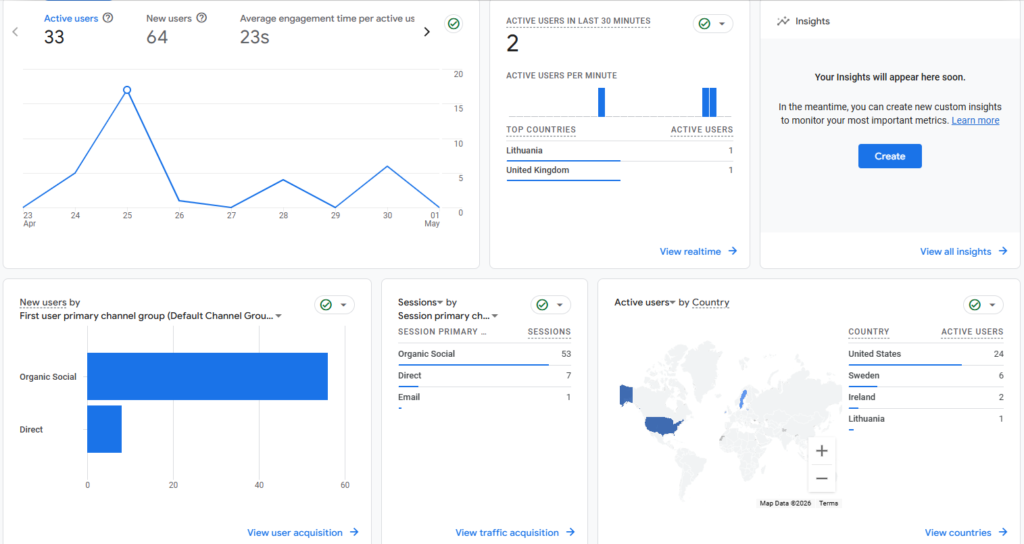
One of the most useful observations from this article was how strongly traffic source influenced behaviour.
The majority of sessions came through Facebook posts linking to the article, but not every post created the same quality of visit. Some generated curiosity-driven clicks with very low engagement, while others appeared to attract readers who stayed noticeably longer.
That forced me to think differently about messaging itself.
A headline does not simply attract attention, it creates an expectation in the reader’s mind before they ever land on the page.
If the emotional framing of the post aligns with the emotional tone of the article, behaviour improves. If the framing overpromises or creates the wrong expectation, people leave quickly.
That realisation pushed me much closer toward CRO and behavioural psychology than traditional SEO alone.
Why Engagement Metrics Need Interpretation
One of the easiest mistakes when learning analytics is assuming metrics explain themselves.
They don’t.
A low engagement time can mean:
- poor alignment,
- accidental clicks,
- unclear structure,
- weak hooks,
- or simply that visitors found what they needed quickly.
Without context, numbers become misleading very quickly.
During this article experiment, I noticed something interesting inside GA4: some traffic spikes actually produced weaker engagement than smaller traffic days.
Initially, that felt counterintuitive, surely more visitors should indicate stronger performance?
But behaviour suggested otherwise.
Some audiences were curious enough to click, but not emotionally aligned enough to continue reading while others arrived with much stronger intent and spent longer engaging with the content itself.
That distinction changed how I think about performance entirely!
I stopped asking:
“How many people visited?”
and started asking:
“What kind of visitor did this messaging attract?”
That shift feels subtle, but it completely changes how you evaluate content.
Behaviour Starts Before the Click
One of the biggest lessons this article taught me is that user behaviour often begins before someone even lands on the website.
The wording of a Facebook post influences:
- expectation,
- emotional framing,
- curiosity,
- and perceived relevance.
Small wording changes created surprisingly different behavioural outcomes.
Posts written with:
- calmer psychological framing,
- stronger emotional recognition,
- or sharper tension
tended to attract more engaged visitors than posts that felt purely informational.
That made me realise SEO and CRO overlap far more than I originally understood … Search optimisation gets attention and behaviour clarity determines what happens next.
This became particularly noticeable while comparing article performance against search visibility data inside Google Search Console, which I explored further in What Google Search Console Taught Me About SEO Expectations.
Internal links like this became increasingly intentional over time because they help create continuity between related topics while reducing unnecessary cognitive friction for the reader.
The Role of Internal Linking
Originally, I viewed internal linking mostly as an SEO requirement, now I think about it differently.
Good internal linking helps guide behavioural flow.
When someone finishes an article about mental exhaustion, the next useful step might naturally be:
- decision fatigue,
- mental load,
- recovery,
- or simplifying routines.
The goal is not simply keeping someone on the website longer. It is reducing the effort required to continue exploring relevant ideas.
That is why articles like:
- Decision Fatigue: How to Make Fewer Daily Decisions
- The Hidden Reason Your Mind Keeps Working After Work
- and How to Reduce Mental Load: A Simple Weekly Reset That Works
became strategically connected.
The links are not random, they reflect likely behaviour pathways.
That shift, from isolated articles toward interconnected behavioural journeys, is probably one of the most important SEO lessons I have learned so far.
What the Data Started Revealing
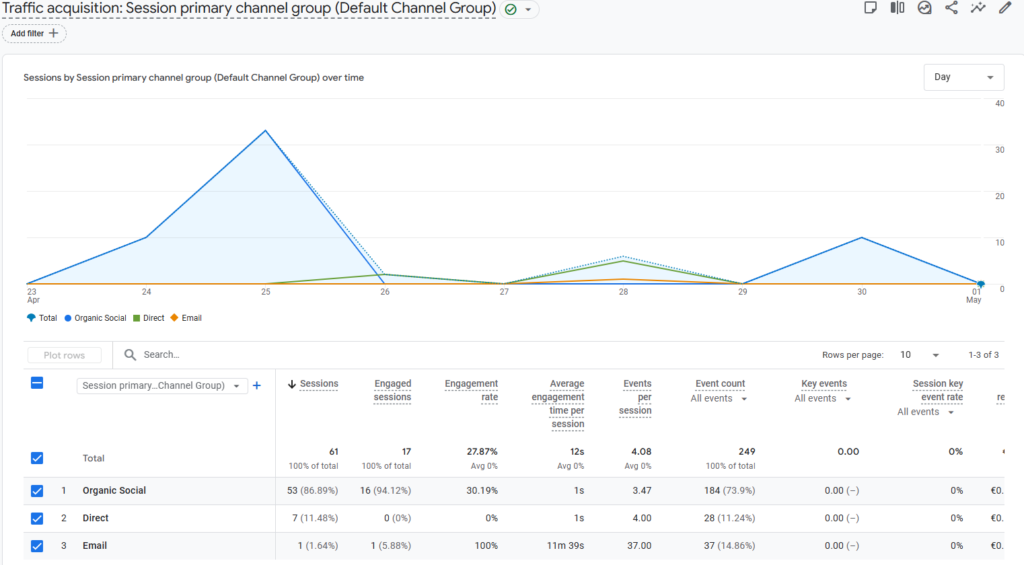
One particularly interesting observation from this report was how dominant organic social became during early growth.
At first, I viewed this positively because traffic itself was increasing, however the engagement metrics underneath told a more nuanced story.
Organic social generated volume, but engagement quality varied significantly depending on:
- article framing,
- audience alignment,
- and expectation matching.
Direct traffic, although smaller, often showed stronger engagement consistency.
That behavioural difference matters because it highlights something many beginners miss:
Not all traffic is equally valuable.
A smaller audience with stronger alignment often produces better behavioural outcomes than larger audiences arriving with weak intent.
That insight completely changed how I think about content distribution.
Why This Matters Beyond Analytics
The longer I work with SEO and analytics, the less technical it feels, at its core, this process increasingly feels observational.
You begin noticing:
- hesitation,
- attention patterns,
- emotional alignment,
- friction points,
- and cognitive overload.
Analytics does not directly explain human behaviour, but it leaves traces behind.
Someone clicks.
Someone leaves.
Someone continues reading.
Someone pauses.
Someone explores another article.
The numbers themselves are only signals.
Interpretation is where the real learning happens and that is probably the biggest thing this article taught me.
SEO is not simply about visibility.
CRO is not simply about conversion.
Analytics is not simply about reporting.
All three are fundamentally connected to understanding human behaviour.
Final Thought
When I published Low Energy Despite Success, I thought I was writing about mental fatigue in midlife.
What I did not expect was that the article would also teach me so much about:
- behavioural psychology,
- audience alignment,
- messaging,
- engagement,
- and how people interact with content emotionally.
The experience shifted how I think about marketing entirely.
Not as persuasion.
Not as optimisation for its own sake.
But as understanding what reduces friction enough for someone to continue paying attention.
And increasingly, that feels like the real skill underneath both SEO and CRO.
Here’s to success (and fewer 404s)
Chris