
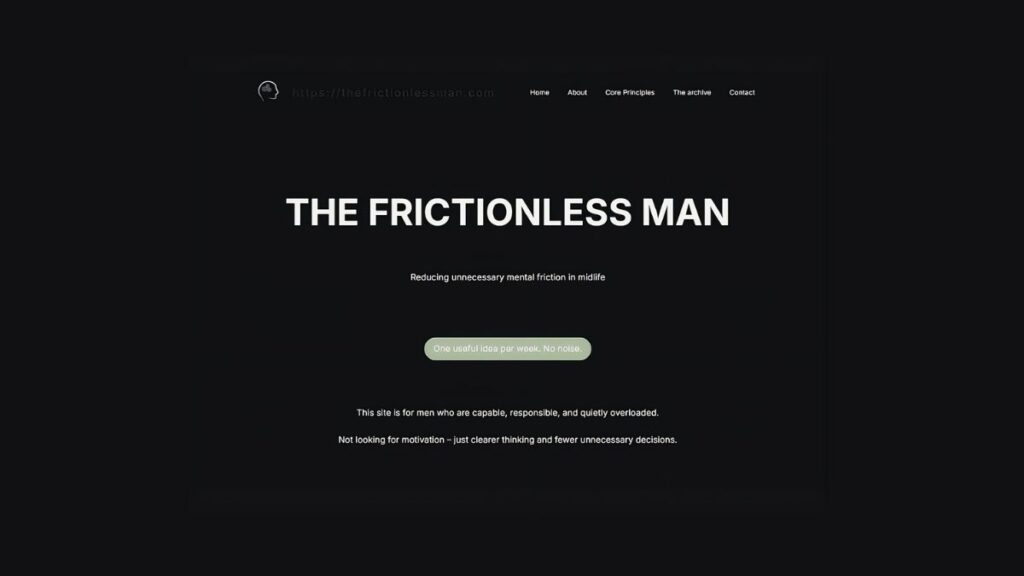
Designing a live content platform to test audience psychology, SEO, and behavioural marketing in real time.
There wasn’t a single moment when The Frictionless Man began. It developed gradually from a question I kept returning to: how do you actually test marketing ideas in a real environment rather than discussing them in theory?
Much of modern marketing advice exists in abstraction — frameworks, tactics, and opinions shared without long-term observation of behaviour. I wanted to understand something more practical: how audience psychology, content structure, and consistency interact over time when applied deliberately.
So instead of analysing someone else’s brand, I built one.
The Frictionless Man was designed as a controlled environment — a place where I could explore positioning, messaging, SEO, and behavioural engagement while documenting the process openly. The goal was never rapid growth or viral reach. It was clarity: understanding what genuinely resonates with a defined audience when strategy is applied patiently and measured carefully. I wrote about this in more detail, Why I Built a Second Website: A Marketing Experiment Platform.
What began as a writing project quickly became something else — a live marketing laboratory.
This article outlines the strategic thinking behind the platform, the decisions made at each stage, and what the ongoing experiments are revealing about attention, trust, and sustainable audience growth.
Executive Summary – Why This Project Exists
The Frictionless Man was not created as a content site, it was designed as a controlled marketing experiment.
The objective was simple: build a platform from zero and test how structured content, messaging, and user experience influence engagement, behaviour, and growth over time.
Rather than relying on theory or second-hand insights, this project applies practical experimentation across SEO, content strategy, and conversion principles. Each article, layout decision, and distribution method is treated as a testable variable.
The focus is not on volume, but on clarity. Content is written for a defined audience — midlife professionals experiencing cognitive overload — with an emphasis on reducing friction, lowering mental load, and improving day-to-day function. This provides a consistent framework for both messaging and measurement.
Alongside the content platform, SEOandCROJourney.com exists to document the process transparently. It captures not just what worked, but what didn’t — including measurement challenges, flawed assumptions, and adjustments made along the way.
The purpose of this project is twofold:
- To demonstrate practical marketing capability through real-world execution
- To build a body of work grounded in experimentation, not theory
This is not a static portfolio. It is an evolving system, where strategy is tested, refined, and improved in real time.
The goal is not to prove perfection, but to demonstrate how marketing decisions are made, tested, and improved under real conditions.
Before writing a single article, I defined a primary reader. Rather than targeting a broad demographic, I focused on a specific psychological profile that repeatedly appeared in conversations, search behaviour, and professional environments I was familiar with.
I noticed a consistent pattern: capable midlife professionals who were not burned out in the traditional sense, yet were experiencing persistent mental fatigue and reduced recovery. Their lives looked stable externally, but internally felt increasingly effortful.
The persona “Mark” emerged as a synthesis of these observable patterns — not a fictional character, but a strategic model used to guide tone, topic selection, and messaging decisions.
Audience Definition: Designing ‘Mark’
The content is written for a specific audience, not a broad demographic.
“Mark” is a midlife professional, typically between 40 and 50, with a stable but demanding career. He is capable, reliable, and used to handling responsibility. On paper, life is working. In practice, it feels heavier than it should.
His stress is not driven by chaos, but by accumulation. Work demands, family logistics, and constant low-level decision-making create a steady cognitive load that rarely switches off.
He does not engage with traditional self-improvement content. He avoids anything that feels overly emotional, abstract, or performative. He is not looking for motivation or inspiration. He is looking for practical ways to reduce friction and regain a sense of control.
This shapes both the tone and structure of the content. It needs to be clear, grounded, and useful without feeling like advice.
Market Observation
The broader self-improvement space is saturated, but much of it is polarised.
At one end, content is highly performative — productivity hacks, optimisation culture, and constant output. At the other, it leans heavily into emotional processing, often framed in ways that do not resonate with this audience.
There is a gap between these extremes.
Many midlife professionals are not burned out, but they are carrying sustained mental load. They are functioning well, but with reduced clarity, lower patience, and persistent fatigue. This experience is common but underrepresented in how it is discussed.
The Frictionless Man is positioned within that gap. It focuses on practical mental relief rather than transformation. The emphasis is on reducing unnecessary effort rather than adding new systems.
Value Proposition
The core value proposition is simple:
Reduce mental friction without overcomplicating life.
Content is designed to:
- Lower cognitive load
- Improve clarity and decision-making
- Create small structural improvements that compound over time
The approach avoids intensity. There are no extreme routines, rigid frameworks, or high-effort systems. Instead, the focus is on adjustments that fit into existing life structures.
This aligns with the audience’s reality, they do not need more to manage, they need less unnecessary friction.
Content Strategy Architecture
Content is structured around repeatable themes rather than isolated topics. Each article addresses a specific type of cognitive friction that appears in midlife.
These themes include:
- Decision fatigue
- Mental load
- Social exhaustion
- Energy management
- Focus and attention
- Recovery and cognitive reset
Articles are written in a consistent format:
- A grounded opening based on real experience or observation
- Clear explanation of the underlying issue
- Practical adjustments that can be tested immediately
- A short framework to summarise the idea
The tone remains steady throughout. It avoids exaggeration, avoids urgency, and avoids over-promising outcomes.
Frequency is controlled, one article per week allows time to observe performance, adjust structure, and maintain quality.
Distribution Strategy
Distribution is intentionally simple.
Primary channel: Facebook.
Each article is supported by multiple posts using different hooks. These hooks are tested across variations:
- Calm framing
- Direct or sharper framing
- Personal or story-driven framing
- More confronting or uncomfortable framing
The purpose is not just reach, but understanding which messaging style drives engagement and clicks.
Rather than promoting multiple articles simultaneously, focus is placed on a single piece of content at a time. This isolates variables and improves clarity of results.
Over time, this creates a body of insight into how messaging influences behaviour.
One lesson became clear very quickly: publishing content is not the same as distributing it effectively. I explored that distinction further in Publishing vs Distribution: The Lesson Most New Websites Learn Too Late.
Conversion Approach
The site is intentionally minimal.
There are no aggressive calls to action or complex funnels. The primary conversion is email subscription, positioned as a natural next step rather than a forced action.
The objective is not immediate conversion, but trust and consistency.
If content resonates, subscription follows.
This aligns with the audience, who are less responsive to pressure and more responsive to clarity.
Measurement Framework
Measurement is centred around understanding behaviour, not just traffic.
Key metrics include:
- Click-through rate (CTR) from social posts
- Engagement rate within GA4
- Average engagement time
- Events per session
Each experiment is designed to isolate a variable. For example, testing different hooks while keeping the article constant.
One important finding from early experiments was the presence of measurement inconsistencies — particularly around engagement time. Identifying and addressing these issues became part of the process itself.
This reinforces a core principle of the project:
Measurement must be trusted before it can be optimised.
Experimentation Approach
The project runs in defined cycles.
Each cycle tests a specific element:
- Messaging (hooks)
- Content structure
- Internal linking
- User flow
Results are reviewed weekly, with adjustments made based on observed behaviour rather than assumptions.
Not every test produces a clear answer. Some reveal flaws in setup or tracking, these are documented as part of the process.
The aim is not perfection, but iteration.
That naturally led into experimenting with headline psychology and audience response patterns, which I documented in What Actually Drives Clicks? A 4-Week Experiment on Hook Strategy.
What This Demonstrates
This project is not intended to present a finished product.
It demonstrates:
- How a marketing strategy is built from first principles
- How audience understanding shapes content and positioning
- How testing informs decision-making
- How measurement challenges are identified and resolved
Most importantly, it shows how small adjustments compound over time when they are applied deliberately.
Final Thought
The Frictionless Man is a simple concept on the surface — a content site focused on reducing mental load.
In practice, it is a structured marketing system.
It tests how people engage with ideas, how messaging influences behaviour, and how clarity can be created in an environment that often rewards noise.
The goal is not scale at any cost.
It is understanding what actually works — and why.