If your website gets visitors but very few of them take action, you’re not doing anything “wrong” — you’re just seeing what most website owners eventually run into. Traffic shows up, numbers look decent, yet results don’t quite follow. I’ve learned that this gap is where Conversion Rate Optimization (CRO) really starts to matter.
CRO is about understanding what happens after someone lands on your site. Instead of immediately chasing more traffic through ads or SEO, CRO focuses on making better use of the visitors you already have. In other words, it’s about paying attention to behaviour — why people click, why they hesitate, and what ultimately earns their trust.
In this beginner’s guide, I’ll walk through what conversion rate optimization is, why it matters, and how it can make a meaningful difference to how your website performs.
What Is Conversion Rate Optimization (CRO)?
At its core, Conversion Rate Optimization is the process of improving your website so that more visitors take a desired action. That action might be a purchase, a form submission, or even just signing up to hear from you again.
For example, if 1,000 people visit your website and 20 of them make a purchase, your conversion rate is 2%. However, if you improve the experience and that number rises to 30 or 40 conversions, you’ve increased revenue without adding more traffic. As a result, the impact is immediate and measurable.
For beginners, CRO is less about tricks and more about understanding people. It’s about observing behaviour, testing assumptions, and making small, intentional improvements. Over time, those improvements compound, and that’s where growth becomes more predictable.
What Is a Conversion?
Before going any further, it helps to be clear on what a conversion actually is.
A conversion is simply the action you want a visitor to take on your website. For example:
- Making a purchase
- Filling out a contact form
- Signing up for a newsletter
- Downloading a guide
- Starting a free trial
That said, conversions look different depending on the type of website. An eCommerce store usually focuses on sales, while a service-based business might care more about enquiries. Therefore, clearly defining your conversions is one of the most important early steps in effective website conversion optimization.
What Is Conversion Rate and How Is It Calculated?
Your conversion rate is the percentage of visitors who complete a desired action. It’s calculated by dividing the number of conversions by the number of visitors.
So, if 500 people visit your site and 25 convert, your conversion rate is 5%. On its own, that number might not seem impressive. However, even small increases can have a surprisingly large effect. Consequently, improving conversion rate often delivers more value than simply increasing traffic.
This is also why conversion rate is such an important performance metric. Traffic tells you who showed up. Conversion rate tells you whether your website is actually doing its job.
Why Conversion Rate Optimization Matters for Your Website
Conversion rate optimization matters because it connects effort to outcome. Instead of throwing more budget at ads or content, CRO helps you get more from what you’ve already built.
Additionally, CRO improves return on investment. If you double your conversion rate, every visitor becomes twice as valuable. As a result, marketing efforts become more sustainable and less reactive.
Just as importantly, CRO encourages better decision-making. Rather than guessing what people want, you rely on real behaviour and testing. Over time, this shifts your website from opinion-driven to evidence-driven — and that’s where real confidence comes from.
CRO works hand-in-hand with Search Engine Optimization, SEO brings traffic to your website whilst CRO converts the traffic into active participants. I have written a Beginners Guide to SEO blog, feel free to read it.
How Conversion Rate Optimization Impacts Website Performance
CRO doesn’t just increase conversions; it improves the overall health of your website.
First, it improves user experience. When visitors can quickly understand what you offer and what to do next, they’re more likely to stay. Consequently, bounce rates drop and engagement improves.
Second, CRO builds trust. Clear messaging, thoughtful design, and visible reassurance — such as testimonials or security cues — help users feel comfortable. As a result, taking action feels less risky.
Finally, CRO improves engagement metrics across the board. Longer sessions, higher click-through rates, and repeat visits all signal that your website is working the way it should.
Understanding User Behaviour Before Optimizing
One thing I’ve learned quickly is that effective conversion rate optimization starts with observation. Without understanding user behaviour, optimisation becomes guesswork.
Visitors leave websites for many reasons: slow load times, unclear messaging, distracting layouts, or forms that feel like too much effort. By identifying these friction points, you can remove barriers instead of adding features. Consequently, users move through your site more naturally.
It’s also important to consider intent. Some visitors are researching, while others are ready to act. Therefore, aligning your content and calls to action with user intent makes conversion rate optimization far more effective.
Key Elements That Affect Conversion Rates
Several elements consistently influence website conversion rates.
Design and layout matter because clarity reduces cognitive load. When pages feel simple and focused, users know what to do next.
Page speed is another major factor. If a site feels slow, people leave — often without thinking twice. As a result, conversions disappear before you even have a chance.
Mobile optimisation is equally critical. With so many users browsing on phones, responsive design is no longer optional. I wrote a blog about Optimizing for Mobile and how critical this is. Additionally, clear value propositions and well-placed calls to action guide users forward.
Finally, trust signals — such as reviews, testimonials, and security badges — help reduce hesitation. When users feel reassured, they’re far more likely to convert.
Common Conversion Rate Optimization Mistakes
CRO is powerful, but it’s also easy to get wrong.
One common mistake is relying on opinions instead of data. While intuition has its place, assumptions often miss what users are actually experiencing. Another mistake is changing too many things at once. As a result, it becomes difficult to understand what actually made a difference.
Ignoring mobile users is another costly error. Finally, expecting instant results can lead to frustration. CRO is an ongoing process, and progress often comes from steady, incremental improvement rather than dramatic wins.
What Is the Conversion Rate Optimization Process?
The CRO process follows a clear structure.
First, you collect data using analytics and behavioural tools. Next, you identify where users drop off or struggle. Then, you form a hypothesis — for example, simplifying a form might increase submissions.
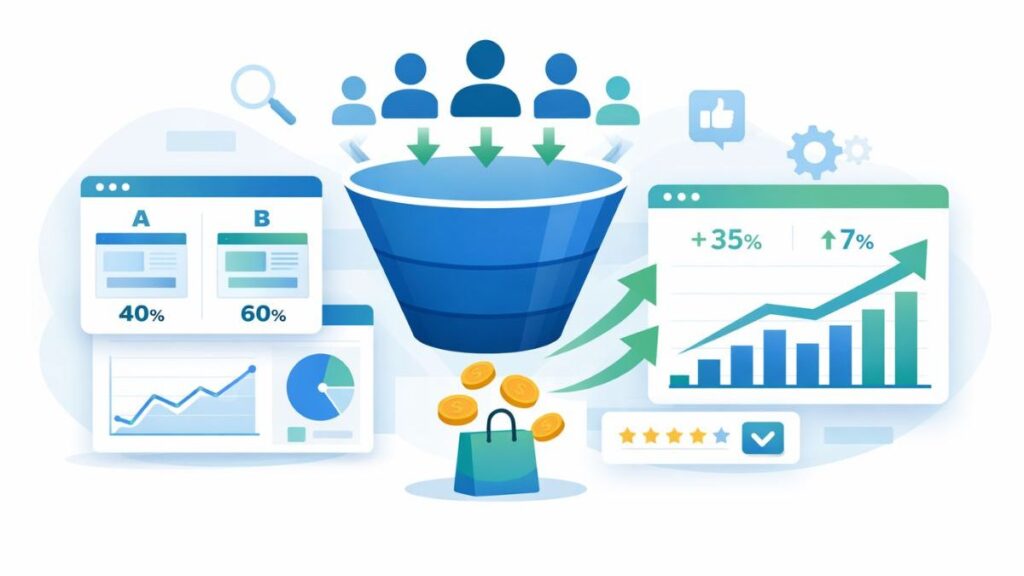
After that, you test the change, usually with A/B testing. Finally, you analyse the results and apply what you’ve learned. Consequently, CRO becomes a cycle of learning and refinement, not a one-time task.
CRO Testing Methods Explained Simply
A/B testing is the most common CRO testing method. It compares two versions of a page to see which performs better. Meanwhile, multivariate testing looks at multiple changes at once, although it usually requires more traffic.
Usability testing helps uncover confusion points, while heatmaps and session recordings show how users interact with pages. Together, these methods remove guesswork and replace it with clarity.
Best CRO Tools for Beginners
While strategy comes first, tools make CRO practical.
Google Analytics shows how users arrive, where they go, and where they leave. It helps identify high-traffic pages with low conversion rates and tracks funnels over time.
Hotjar and Microsoft Clarity reveal behaviour visually through heatmaps and session recordings. They show what analytics can’t — hesitation, frustration, and confusion.
A/B testing platforms allow you to test ideas instead of debating them. Meanwhile, tools like Crazy Egg help optimise layout and content visibility.
User feedback tools, such as on-site surveys, add another layer by letting visitors tell you what stopped them from converting.
Importantly, tools don’t replace thinking. They support it. When used well, they reduce guesswork and help you make better decisions.
Conversion Rate Optimization Best Practices
Strong CRO fundamentals go a long way.
Focus on one clear goal per page. Simplify user journeys wherever possible. Use benefit-driven messaging and clear calls to action. Additionally, prioritise mobile-first experiences.
Small improvements, applied consistently, create momentum. Over time, those changes add up.
How Long Does Conversion Rate Optimization Take to Work?
Some CRO improvements show results quickly. Others take time, especially when traffic is lower.
Because of this, CRO works best as an ongoing practice rather than a short-term project. Over time, small gains compound into meaningful growth.
CRO vs SEO: What’s the Difference?
SEO brings people to your website. CRO helps them take action.
On their own, each has limits. Together, they reinforce each other. Without CRO, SEO traffic can underperform. Without traffic, CRO has nothing to optimise. Therefore, combining both leads to stronger, more sustainable results.
Who Should Invest in Conversion Rate Optimization?
Any business with website traffic can benefit from CRO — small businesses, eCommerce stores, SaaS companies, and service providers alike.
In fact, CRO is especially valuable when budgets are tight. By improving what already exists, it levels the playing field.
How to Get Started With Conversion Rate Optimization
Start with your most important pages — landing pages, product pages, or contact forms. Define clear goals, track conversions, and begin with small tests.
Over time, CRO becomes less intimidating and more intuitive. And if needed, working with a CRO specialist can help accelerate learning.
For more practical strategies, check out HubSpot’s conversion rate optimization guide.
Conclusion: Why Conversion Rate Optimization Is Worth Paying Attention To
Conversion rate optimization isn’t about squeezing more out of people or chasing quick wins. At its best, it’s about paying closer attention — to behaviour, to intent, and to the small signals visitors give you every time they interact with your website.
What draws me to CRO is that it sits at the intersection of logic and empathy. You’re looking at data, patterns, and numbers, but you’re also asking very human questions: Is this clear? Does this make sense? Does this feel trustworthy? Often, the biggest improvements don’t come from dramatic redesigns, but from removing friction, clarifying a message, or simply making the next step easier.
CRO also changes how you think about growth. Instead of constantly pushing for more traffic, you start focusing on quality — on making the experience better for the people who are already there. Over time, that mindset leads to more sustainable results and far fewer wasted efforts.
If you’re new to conversion rate optimization, the most important thing is to start small. Observe how people use your site. Test one idea at a time. Learn from what doesn’t work as much as what does. This isn’t about perfection; it’s about progress. For me, CRO is an ongoing learning process — one that rewards curiosity, patience, and a willingness to question assumptions. And if this guide helps you start looking at your website a little differently, then it’s already done its job.
Here’s to progress (and fewer 404s)
Chris